
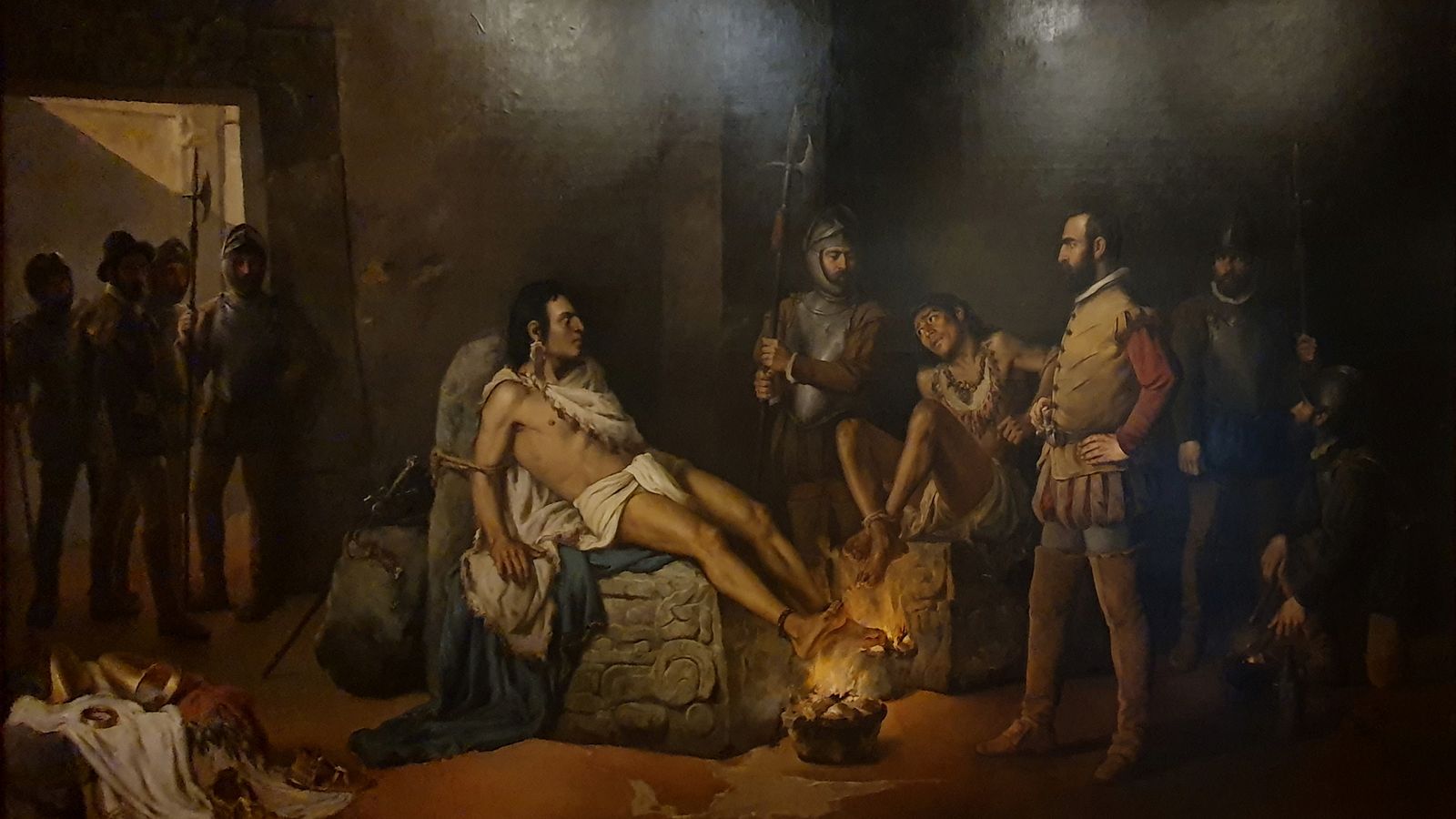
For the better part of seventeen years, the nation of Mexico has been at war with itself. On one side of the conflict is the internationally recognized Mexican government, armed with modern guns, tanks, airplanes, and, at least generally, the support of the Mexican people. But the force that makes up the other side of the conflict is not a legion of freedom fighters, or a breakaway military warlord. In fact, it’s not even one cohesive army—because the other side of Mexico’s de-facto civil war isn’t an army at all.
Mexico is at war with its drug cartels, an asymmetric, decentralized network of gangs and criminal syndicates that have been able to take their country to the brink. With no single leader, a whole lot of heavy weaponry, and the single objective of profit, the cartels have pushed an offensive that’s more deliberately sadistic than nearly any modern nation would even dare attempt. And the cartels don’t just control drugs, either; they control land, and the villages, towns, and even cities who live under their iron fist.
This article explores cartel country to the fullest: what it’s like to live under one of the most brutal regimes in the world, how the situation ever got so bad, and what, if anything, Mexico can do to take back its own future.
Key Takeaways
- Mexico’s drug cartels have created a de-facto civil war, controlling vast territories and operating with heavy weaponry.
- The cartels’ primary goal is profit, using violence and intimidation to control drug routes and extort local businesses.
- The Mexican government’s efforts to combat the cartels have been largely ineffective, with corruption and military operations failing to curb their influence.
- Cartels like Sinaloa and Jalisco New Generation use different tactics, from diplomatic extortion to brutal violence, to maintain control.
- The cartels’ reach extends internationally, with significant operations in the U.S. and other countries, making them a global security threat.
Lay of the Land
Before we can get into any specifics of what’s going on in Mexico’s internal conflict, we’ve first got to establish what sort of conflict we’re talking about. In many ways, the violence in Mexico bears resemblance to the violence that takes place in criminal underworlds across the globe: an intensely adversarial network of gangs, syndicates, and other organizations, all competing with each other for business, while trying to evade the state authorities who could end their business entirely. At the same time, there are parts of the Mexican conflict that appear nearly inseparable from a civil war.
Mexico’s cartels don’t want to bring down the Mexican state; in fact, they rely on the Mexican state’s perceived legitimacy on the world stage in order to keep other actors, and specifically the United States, out of their way. But despite their interest in preserving some semblance of a Mexican government, the cartels walk an incredibly fine line: diminish the government’s power and control as much as they possibly can, without letting it fall apart entirely. We’ll be referring to Mexico’s situation as a war on drugs, a war between crime syndicates, and even a civil war; all are most of the way to being accurate, but none can tell the whole story by themselves.
No economy can exist without demand, and Mexico’s vast drug economy is no different. Despite a relatively low appetite, and relatively low purchasing power, for illicit drugs inside Mexico’s own borders, the country’s northern neighbor is another matter entirely, and it’s the United States of America’s intense hunger for drugs that keeps Mexico’s cartels in business. With some six percent of the country’s three-hundred-million people believed to use illicit drugs, the USA has more than enough clientele to keep the cartels working overtime, and the nation’s wealth is such that dealers can demand far more for a unit of a certain drug than they could elsewhere. Not only that, but the United States’ long, over-land border with Mexico presents a golden opportunity for drug smuggling, so lucrative and convenient that criminal syndicates all up and down Latin America are forced to work with Mexico’s cartels in order to do business.
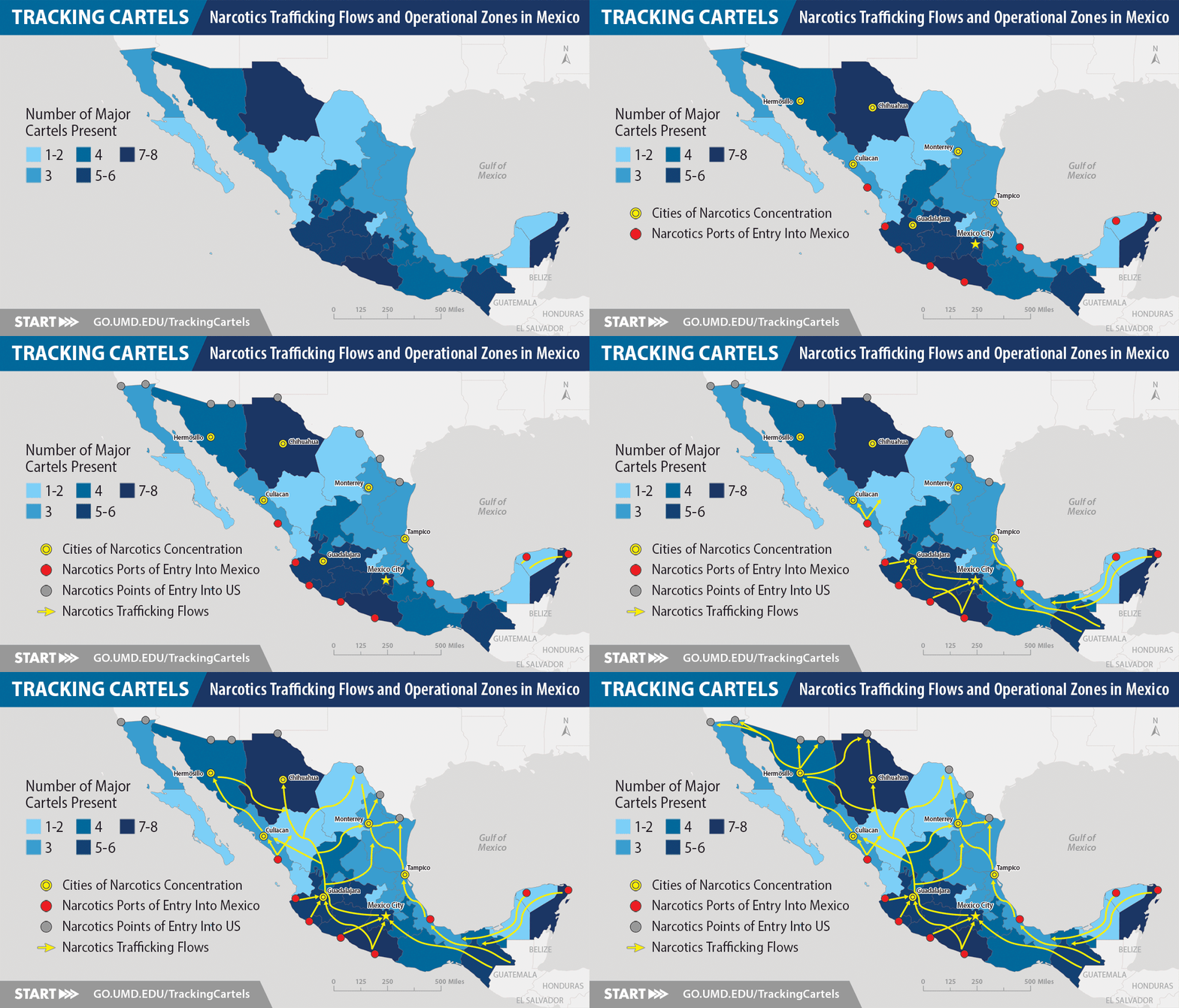
With Mexico acting as a convenient geopolitical bottleneck for most over-land or coastal drug shipments, cartels have an easy path to act as a middleman for the American drug market, controlling prices, shipping routes, and sprawling networks of growers, smugglers, and dealers. Not only that, but they’ve got the connections on both sides of the border to facilitate safe transfer, avoid or pay off the US Border Patrol, and move product in massive amounts by road, rather than take the chance of traveling by boat, plane, or submarine. They maintain a major presence in every American port of entry along the border, and are adept at using the United States Postal Service to ship drugs in, with cocaine, heroin, fentanyl, methamphetamine, and much, much more, all streaming in through pathways and mechanisms that Mexico’s cartels have locked down.
Now, it’s tempting to take a map of Mexico and simply break it into lines of control, as if each individual cartel, as well as the Mexican government, each owned clearly demarcated sections of territory and went to war over each other’s borders. But Mexico’s informal civil war is a lot more complicated than that, with most areas of the country claimed by multiple cartels at once. The reason for this is that Mexico’s entire narco-economy is built around controlling the flow of drugs toward, and then into, the United States.
In this sort of environment, it’s important to hold territory, whether it be an entire region of the country, or a city block, or even a few kilometers of road. But the reason that territory is important has nothing to do with the ordinary people who live there. Control the land, and that’s more sprawling valleys that can grow drugs without interruption; more kilometers of road where a shipment can travel north unmolested; and more locations where those same drugs can be processed, stored, or even consumed, without another cartel or the Mexican government causing problems.
As such, many of Mexico’s states are tightly contested between a range of cartels. With shipments coming into Mexico from all over the world, in ports mainly concentrated through the southwest states and the Yucatan peninsula, each cartel works hard to establish its own foothold and secure processing routes, while states along the US border, specifically the sparsely populated states of Sonora and Chihuahua, are some of the country’s most tightly contested battlegrounds as cartels compete for dominance in a limited number of American points of entry. In the Mexican interior, it’s all about which cartels can either protect their own smuggling routes, or lock down an area of the country and demand tribute from any smugglers who wish to pass through.
As of 2020, the American Drug Enforcement Administration, or DEA, counted six cartels as the most influential in all of Mexico. The Sinaloa Cartel, which boasted some hundred thousand members or more in 2009, has its historic routes in the states of Sinaloa, Durango, and Chihuahua, where massive amounts of Mexican opium and marijuana are produced. The Jalisco New Generation Cartel, or CJNG, has spent over a decade being considered one of Mexico’s most sadistic cartels, but now has surpassed the Sinaloa as both a national security threat in Mexico, and the largest and most effective supplier of drugs in the US. The Juarez Cartel and the Los Rojos Cartel control some of Mexico’s most important territory, with Juarez situated near the US border and Los Rojos controlling incoming supply from Latin America and the world. La Familia Michoacana, operating out of the state of Michoacan in Mexico’s southwest, has largely splintered into a range of sub-factions, but these sub-factions still exert a tight grip on the region. And the Gulf Cartel, based in the Mexican city of Matamoros on the southern bank of the Rio Grande, and their long-time frenemies Los Zetas in the nearby city of Nuevo Laredo, are fixtures in any effort to bring drugs across the border into America.
Alongside these six major cartels are an absolute mess of breakaway factions, splinter groups, regional enclaves, and rogue interests, all competing with each other for the biggest possible piece of the pie in Mexico’s drug trade. Their international links run not just through the United States, and not just down into Central and South America, but all over the world. And the Mexican government, currently led by President Andres Manuel Lopez Obrador, or AMLO, is just as important a player, with AMLO and his administration insisting that they maintain control across Mexico, despite the reality being very clearly different.
Standing sometimes beside the Mexican government, and sometimes at odds, is the government of the United States, with its own vested interest in combating Mexico’s cartels both on Mexican and American soil. It’s in the tangled web of alliances, animosity, and violence that Mexico’s civil war really exists, and it’s ordinary Mexican civilians, caught in a constant crossfire, who have borne the brunt of this war for decades.
Past and Present
Drug syndicates haven’t always been major players in Mexico, but their rise to power began long before the official start of Mexico’s drug war in 2006. For as long as the United States has had an appetite for drugs—which is to say, for a very long time—Mexico has been just as important a smuggling route as it is today. During America’s Prohibition era, from 1920 to 1933, Mexican bootleggers were instrumental in keeping the United States’ criminal networks supplied with alcohol, and Mexico has had the requisite infrastructure to smuggle drugs at scale since the 1960s.
But the story of the Mexican cartels actually begins with a Colombian one: the Medellin Cartel, run by one Pablo Escobar, who needs no introduction. The Medellin Cartel, along with the Cali Cartel, relied heavily on Mexican transshipment routes to do their business, and in 1980, Mexico grew a criminal syndicate to match.
It was known as the Guadalajara Cartel, formed under the control of a man named Miguel Angel Felix Gallardo. In many ways, the Guadalajara Cartel was in the right place at the right time, as the United States began to crack down on sea trafficking routes across the Gulf of Mexico at around the same time as Guadalajara began to accrue power. But at the same time, they also filled an emergent need to oversee distribution and protection of Colombia’s product, something that the Medellin and Cali Cartels couldn’t manage directly. With the Guadalajara Cartel came centralization, coordination, and unity between the opium and cannabis growers and the cocaine traffickers who had already been spread throughout Mexico. As their power grew, they evolved from a mere group of errand boys into a group with their own, real negotiating power, and became equal partners with the Colombians.
But this early rise came during the 1980s, where Mexico’s dominant PRI Party, a deeply corrupt and autocratic government, were in the waning days of a 70-year-long, continuous rule. Between the PRI’s willingness to look the other way in exchange for some coin, and their tendency to target crops rather than leadership structures when they did attempt to tamp down on the cartels’ power, they provided a fertile environment for the Guadalajara Cartel to amass power and build their criminal networks without interference. When Miguel Gallardo was arrested in 1989, and the cartel splintered into a range of competing factions between Sinaloa, the Gulf of Mexico, Tijuana, and elsewhere, they were largely free to establish spheres of influence and battle for dominance with each other.
That all changed in the year 2000, when the PRI’s hold on power had finally loosened too far to hang on. In that year, Mexico’s conservative PAN party gained the presidency, kicking off a wave of crackdowns against the cartels. Homicide rates in the country, generally high as a facet of the cartels’ battles with each other, fell over the six years that the PAN’s first president, Vicente Fox, held power, and in 2006, his replacement, President Felipe Calderon, took things a step further.
In an act that would later be considered the start of Mexico’s drug war, Calderon would send 6,500 troops to his own home state of Michoacan, in a campaign meant to eliminate the influence of cartels in the area. Over the following years, Calderon’s administration would scale up deployments massively, with as many as 45,000 soldiers assisting local and federal law enforcement.
Whether he intended it or not, Calderon’s actions set off a powder keg in Mexico, especially in the states of Michoacan, Guerrero, Tamaulipas, Chihuahua, Sinaloa, Nuevo Leon, and Baha California, where many of the most important smuggling operations had been taking place. Although the Mexican government was able to capture or kill dozens of drug lords, they also caused the cartels to retaliate not just against Mexican soldiers, but against each other. The introduction of the Mexican government into the midst of already-simmering tensions between the cartels sparked a violent opportunism across the criminal underworld, with each cartel looking to take advantage of the violence and consolidate their own power.
Although figures are unclear, some sources estimate that well over 120,000 people were killed in the violence during Calderon’s six years in power, from 2006 to 2012. But that bloodshed did anything but eliminate the cartels; instead, they militarized, and spread their networks of influence outward, while Calderon’s military was largely ineffectual in carrying out everyday police and anti-trafficking operations.
The following administration, under President Enrique Peña Nieto, didn’t fare much better. Despite his pledges to focus in on protecting civilians rather than capturing kingpins, Peña Nieto proved to have only a temporary impact on the cartels; after a few years of lowered homicide rates, the cartels adjusted to Peña Nieto’s leadership style, and by the end of his term, the Mexican homicide rate was higher than ever before. This was partly due to some of the power and control changes among the cartels during these years, and partly due to the short-lived rise of the Grupos de Autodefensa Comunitaria, vigilante paramilitary movements that had made their best effort to take up arms against the cartels. Between the cartels’ ability to disrupt and stamp out the paramilitary groups, their ability to carry out brazen kidnappings and murders, and their 2015 jailbreak of kingpin Joaquin Guzman, better known as El Chapo, they were not significantly diminished by the Peña Nieto administration. In fact, they learned hard lessons that would carry them to even greater successes in the future.
And finally, there’s AMLO, Mexico’s current president and an unlikely candidate, to say the least, when it comes to being able to tamp down on Mexico’s cartels. His administration’s pursuit of anticorruption, decriminalization, and amnesty programs are a very different approach, on paper, than that of his predecessors. However, he’s had no more luck than the rest of Mexico’s beleaguered presidents, and the failure of his “Hugs, Not Bullets” approach to policy has pushed Mexico back into military operations to combat the cartels, even after AMLO declared an end to the Mexican drug war early in his presidency.
Major black eyes for the administration, like a failed attempt to capture kingpin Ovidio Guzman Lopez that saw the newly established Mexican National Guard outfoxed by some 700 heavily armed cartel enforcers, certainly haven’t helped matters. Mexico’s defense spending has gone through the roof, more troops are deployed, but fewer confrontations with the cartels take place, and although individual cartels have risen and fallen with time, today’s cartels are just as powerful as they’ve ever been. Arrests or murders of high-ranking cartel members invariably result in extreme retaliation, while ambitious kingpins are essentially free to embark on expeditions into each other’s territory, in a cycle of escalation that still hasn’t seemed to peak.
And just as important as tracking the success of the cartels against the government is tracking the cartels against each other. When the Guadalajara Cartel was broken apart and its major transport routes were designated as territory for individual drug lords, five cartels were born from the ashes: the Tijuana cartel overseeing Tijuana, the Juarez Cartel overseeing the city of Ciudad Juarez, the Sonora Cartel in Mexico’s Sonora state, the Gulf Cartel overseeing multiple cities near the US border, and finally, the Sinaloa Cartel along the Pacific coast. Those original five would go through a long list of changes: the Beltran-Leyva organization would splinter off from the Sinaloas before themselves dividing in 2010; the Sonora Cartel would be reformed into the Sinaloa Cartel.
The Gulf Cartel bred several breakaway factions, most notably Los Zetas and the Knights Templar Cartel. And the Milenio Cartel, which became independent from the Sinaloas in the early 2000s, has since disbanded, with many of its kingpins and enforcers realigning into the most powerful cartel currently at work in Mexico: the Jalisco New Generation Cartel.
In the months and years between every individual rise, fall, and rebirth, have been a long succession of temporary alliances, civil wars, and attempts to unify a cartel here and a cartel there into a much more cohesive central body. Assassinations between the cartels, and even within one cartel, are commonplace; so too are the desecrations of bodies, the clear and visible marks of torture that one cartel will ensure to leave on the body of another cartel’s deceased, now-former member. A long line of ambitious drug kingpins have led to a long line of rogue and breakaway factions, while the arrest or killing of a kingpin will often prompt a wave of internal violence as the cartels decide who will take their place.
Paramilitaries, Propaganda, People
Mexico’s major cartels may be, in essence, very big gangs, but just that label alone would badly undersell their actual ability to bring weapons, expertise, and manpower to bear. In essence, each cartel has the capacity to act as a paramilitary organization, often paying large sums of money in order to recruit former troops from the Mexican military. Elite units are in particularly high demand, and considering that the cartel can protect drug shipments worth eight figures, while keeping these troops very satisfied by paying four or five figures per job, they more than earn the steep fees they’re worth.
Beyond their simple ability to fight, they come with valuable insight into the tactics that the Mexican military intends to use in battles against the cartels. They bring discipline in the chaos of combat, they create kill zones and visualize battles in three dimensions, and the cartels are generally more than happy to set them up with an equally important partner. That would be cannon fodder, in the form of young, naïve gangsters who’ve consumed enough amphetamines that they’re willing to run directly into the line of fire.
And the cartels don’t just fight with AK-47s, either. In terms of their small arms, many cartels are able to source reliable, well-made rifles and submachine guns like the Israeli-made Galil ACE, manufactured in Colombia and trafficked to Mexico quite easily. American M-16s are just as much a fixture in cartel country too. Those guns that aren’t trafficked in are typically stolen or looted from the Mexican police and military, and when cartel weapons are seized, it’s generally not too difficult to buy them back from corrupt government officials. In addition to rifles, cartel enforcers are increasingly equipped with body armor, combat harnesses, sniper rifles, and rocket-propelled grenades, or RPGs. And then there’s so-called narco-tanks, massive improvised armored vehicles that are armed to the teeth with 50-caliber guns and ready to chew through any less-armored opposition they find. Car bombs and improvised explosive devices are commonplace, and ambushes and so-called burning barriers, using cars that are set on fire, are favored weapons for cartels who are essentially fighting on their territory.
And when the cartels do lock down a certain section of Mexico, their priorities quickly shift from beating back adversaries to ensuring that no one on their territory gets in the way of business. On the land they control, the tools the cartels use to keep order bear a strong resemblance to all manner of dictatorships, past and present. Torture and extrajudicial execution, often at random or on a whim, are very common in cartel-controlled areas, and at least eighty thousand civilians have been disappeared by the cartels since 2006.
The discovery of mass graves, often with dismembered corpses found inside, is all but commonplace in today’s Mexico. The targets of such violence can be anyone from local officials, to civil-rights advocates, to journalists, to foreign officials—but just as often, it’s directed against ordinary Mexican citizens. Some, we can only presume, were simply in the wrong place at the wrong time, while others may have lived under the cartels for years, or had only a few moments of contact with them.
What’s done to those people is just as much about the rest of the population as it is about targeting them personally, and judging by the behavior of the cartels, there seems to be little point in simply disposing of a corpse that can be used to send a message. When bodies show up in cartel country, they’re often beheaded, or bear shrapnel wounds and the marks of horrific, point-blank explosions. Others might be stuffed into tires or oil drums and set on fire, or bear horribly disfiguring acid wounds.
When the bodies are dumped, it might well be on the side of a busy road, or hung from a lamppost—and that’s when they’re killed in private. In other cases, people are disappeared or even executed outright when they’re in public, or even during social occasions where the cartels know they’ll be surrounded by friends and family. Every killing is itself a threat to onlookers—and in a place where threats are so abundant, the cartels would risk a massive loss of face if their threats weren’t acted on.
Luckily for the cartels, they appear to have no such qualms about killing—and unlucky for ordinary Mexicans, such constant violence lends itself to an atmosphere of deep, mortal fear, where any act that might oppose the cartels simply isn’t worth doing.
Brutality is a powerful tool on its own, spread by word-of-mouth and by the public display of the cartel’s dead or dying enemies, but even more powerful is propaganda. Newer cartels, like the CJNG, emphasize Robin-Hood-like themes of altruistic banditry, or brazen shows of defiance against the Mexican government, almost as if to say, “however bad we might be, we’re still the angels of the Mexican people.” These come amidst a barrage of torture videos, body dumps, and images of CJNG’s mutilated enemies, all directed toward those who might stand against them in the future. The message, overall, is quite clear: CJNG doesn’t want to hurt your average Mexican citizen, but they’re absolutely not to be crossed.
It’s not just CJNG that likes its propaganda, and the propaganda doesn’t just come by videos, either. Mexico’s cartels have popularized a genre of music called narcocorridos, where singers glamorize and extol the lifestyle of drug lords while backed up by trumpets and accordions. An excerpt from a song called “La Familia Michoacana”, focused on the cartel of the same name, reads: “Continue working hard / No power to stop them / If you keep provoking them / You will pay the consequences / They have made clear that their places are respected.” Of course, it flows better in Spanish. Hip-hop and rap music focused on the cartels are just as common, and along the streets and buildings in cartel-controlled areas, reminders of the syndicates are everywhere from graffiti to billboards. Cartel slang, cartel tombs, cartel television, and even cartel beer have become instruments of social control, and of course, it should go without saying that things like unrestricted freedom of the press simply do not exist on cartel land.
In terms of their membership, most cartels recruit heavily from disenfranchised, poor young men, similar to other criminal organizations and non-state groups around the world. On the priority list are police officers, border agents, and ex-military, partly because of their operational expertise, and partly because of all the information about police and border control that they bring with them. American recruits are just as important, not just because they can freely navigate the American side of the border, but because they can blend in far better than someone sent from Mexico.
Poor, and often angry, young Mexicans are also prioritized, but for different reasons; lacking alternatives, social support, and sometimes even family connections, they’re all but expendable, strongly incentivized to try working their way up but powerless to stop themselves from being used as pawns. And when compared to the poverty and lack of education that’s widespread in many parts of Mexico, it’s not hard to see why a young person might roll the dice and see if they can make it with the cartels. Play the cards right, and they can be swimming in cash within just a few years, acting as a highly respected shot-caller with full access to mansions, fast cars, women, and, most of all, power.
Now, if you’ve been asking yourself where the Mexican government is to rein the cartels in, you’re not the only one, but standing up to syndicates like these is far more dangerous in practice than in theory. Attempts to enforce judicial order on the government’s behalf can often be a fool’s errand; by example, when a federal judge approved the extradition of a high-ranking CJNG member to the United States, they quickly became the latest in a long line of judges killed in retribution for issuing such an order. Many more judges have since suffered the same fate, and they aren’t the only ones either; in 2020, a recently-former governor of the state of Jalisco was assassinated in a restaurant bathroom, and in 2021, the police chief responsible for the state of Sinaloa was killed in a hail of over two hundred bullets while driving with his bodyguards. Party leaders, political candidates, local legislators, and city police chiefs have suffered the same fate, not just in ones and twos, but in the dozens and even the hundreds.
And at any moment, tensions deep in cartel country have the potential to break out into large-scale violence. By example, take the chaos that took place over just a few days in August 2022. On August 9, one cartel’s enforcers set at least 25 convenience stores and 19 vehicles on fire in retribution for the arrest of one of their high-ranking members; two days later, at least ten people were killed at fast-food restaurants and convenience stores in response to gang battles that had taken place at a nearby prison earlier in the day.
In the early hours of the following morning, in a completely different part of Mexico, numerous vehicles and convenience stores were set on fire and dragged into blockades, in further protest of the arrest we mentioned previously. This cycle, which took place just in the span of a few short days, is one that repeats anytime a cartel or the government upsets the fragile balance of power that exists in a given moment.
For citizens who might wish to take up arms and defend themselves, standing up to the cartels is no easy task, especially when they’re facing heavy guns and narco-tanks. Some resistance groups do exist, drawing their own recruits from the family members of people who were killed and disappeared by the cartels, and at times, the leaders of these self-defense militias can operate in public without fear of retribution in the areas they’ve secured. Sometimes, the groups are able to organize robust-enough highway patrols and security operations that they can send cartel members packing without a firefight, and they’re provided weapons, on occasion, by local police.
But in a war where one side is willing to maim and disfigure the bodies of its enemies, it’s often difficult for the other side to defend itself without engaging in extreme violence themselves, and in Mexico, it’s no different. In recent years, the Mexican government has become less and less willing to support militias, and has tried to set up a national guard as an alternative. But in practice, these decisions often reward the only civilians in Mexico willing to stand up to the cartels by simply leaving them out in the cold.
Sinaloa
Watch The Project Briefing
Open Video
Video Briefing
Cartel Country: Where Drugs Rule All
Because of how dominant the Sinaloa Cartel has been in Mexico, and for so long, there’s plenty of information available about what it’s like to live under their control. As expert Vanda Felbab-Brown explained, in a series of articles on how both the Sinaloa Cartel and the Jalisco New Generation Cartel manage their territory, the two groups’ methods of social control are actually fairly different, and for our purposes today, it’s the Sinaloa Cartel who we’ll dive into first.
At this point in its decades-long history, the image the Sinaloa Cartel presents on its own territory is largely one of respect, moderation, and restraint, similar to the sort of old-world mafioso rule we might associate with much of the organized crime of the twentieth century. Now, that’s not to say that life under the Sinaloa Cartel is straight out of The Godfather; anything but. Instead, the cartel aspires to a sort of sophisticated, orderly criminality on the territory they control, where violence certainly isn’t unheard-of, but it’s nonetheless used as a last resort. It’s instrumental violence, done for a specific purpose, rather than the sort of gratuitous violence that characterizes the cartel’s rivals.
On their land, big or even international businesses are forced to pay regular tribute to the Sinaloa Cartel, but it’s a process that largely takes place without the chaos that comes from a range of petty gang bosses trying to impress their cartel superiors. As a businessman quoted by Vanda Felbab-Brown put it, “Sinaloa, Caro Quintero’s faction, now controls the top extortion in Acapulco. But it’s much better than before.
Straight-forward, easy. You don’t have to pay weekly and to men brandishing their weapons in your face; just once every three months now, and it’s calm, you don’t see the weapons.” Of course, it’s not our intention here to draw too meaningful a distinction between ‘good extortion’ and ‘bad extortion’, but it’s important to note how this sort of relative restraint keeps the Sinaloa Cartel from having to worry about too much local discontent on the territory they control.
It’s the same principle we explained at the outset: the cartel is a moneymaking organization, and as long as their business remains uninterrupted, ordinary citizens should have little to fear.
But while the Sinaloa Cartel isn’t over-the-top violent against ordinary people in the territory they control, the same can’t be said for their front lines and their border regions, where the Sinaloa Cartel has been among the most successful expansionist cartels in Mexican history. From Ciudad Juarez to Tijuana and elsewhere, the Sinaloa Cartel have been more than willing to take territory by force, engaging in all the same torture and bloodshed in order to cow their rivals into submission. And while their extortion of businesses isn’t quite so stereotypically cartel-ish as one might expect, it’s no less complete; as Felbab-Brown explained in a separate report, the Sinaloa Cartel now runs every aspect of Mexico’s fishing industry, from boats on open water to sale in restaurants, and they’re more than happy to extend that level of control over the entire vertical chain of as many industries as they can. Yet again, the cartel is, above all else, a moneymaking organization.
For a cartel as large and powerful as the Sinaloas, it’s difficult to keep any sort of consistent, top-down, centralized authority. After all, in such a hierarchical, sprawled-out system, the person in charge could be a kingpin if you’re at his mansion—or it could be the low-level enforcer sitting in the passenger seat, as you and a few guys try to get a semi-truck to the US border. As such, the cartel’s many smaller cells, gangs, and the support bases of each kingpin are given quite a bit of latitude to operate as they see fit, so the treatment that one community may receive under the Sinaloa Cartel could be very different from another.
On a local level, street bosses pay a certain tribute for the Sinaloa Cartel’s protection, they work inside the bounds of whatever strategy the cartel has passed down, and however that happens really isn’t the cartel’s concern. But by and large, the Sinaloa Cartel’s operatives are relatively consistent in their willingness to keep daily life peaceful as long as the money flows in.
In many pockets of their territory, the Sinaloa Cartel even fills rather helpful roles in everyday life. Designated cartel officials serve as arbiters of minor disputes, distribute financial or social support to those in need, and act as informal policemen to keep order, with most of the cartel’s business kept out of the way. They might keep close political relationships with priests, municipal officials, or any local police forces that still do exist, using them not just as extensions of the cartel’s will, but critical mediators who can smooth relations between the cartel and the rest of the population.
They give ordinary Mexicans tax breaks and immunity from regulation by keeping out tax collectors and inspectors, and in some areas, everyday inconveniences like speeding and parking tickets are unheard-of. On occasion, they’ve even been known to investigate and solve kidnapping cases themselves, handing alleged kidnappers over to Mexican authorities rather than serving as their own judge, jury, and executioner.
In fact, the Sinaloa Cartel is unusually willing to work with the Mexican government in a variety of situations, mostly owing to the fact that they’ve really got very little to fear from the government in its current state. In recent years, the Sinaloa Cartel has offered to enforce fishing regulation compliance on the government’s behalf, and even check for government-issued fishing licenses while out on the water. Going the opposite direction, local police in cartel-controlled neighborhoods have taken to leaning on the Sinaloa Cartel to enforce laws against petty crimes, and the cartel is often the one building sports arenas, supporting local schools, and paying for block parties and neighborhood festivities, including in places where the cartel has very little business to conduct.
The cartel was even able to work with and enforce compliance around COVID-19, offering cash support and social packages to people who couldn’t work or risked illness in the community. For the Sinaloa Cartel in particular, it’s less a vibe of “you must fear us,” and much more of an “LMAO, it looks like we own this land now, we can’t wait to work with you.”
Jalisco New Generation Cartel
Then there’s the other side of the cartel coin: Mexico’s Jalisco New Generation Cartel, which we’ll refer to as CJNG. To put it mildly, their methods of leadership and social control are rather different than the ones the Sinaloa Cartel prefers—and specifically, they prefer to be a good bit more openly violent. Of course, we certainly wouldn’t want to offend by suggesting that CJNG might be one of the most brutal cartels in Mexican history—but we’d hazard a guess that they might take that moniker as a compliment.
It’s important to note that this particular cartel is a relatively new arrival on the Mexican scene, one that exploded outward from the death of the Milenio Cartel, which was, at the time it dissolved, a loyal deputy organization under the Sinaloa Cartel. After the Milenio Cartel’s fall, the CJNG coalesced under the leadership of a man named Nemesio Oseguera Cervantes, or El Mencho, who today is the most-wanted man in Mexico. Since their initial appearance in 2009, the CJNG has captured a whole lot of territory and waged intense wars of expansion against everyone from the Sinaloa Cartel to the Knights Templar to Los Zetas. Today, they’re the dominant force in almost a dozen Mexican states, and tightly contesting control of several others, while maintaining wide criminal networks in the most populated US states, nearly all of Latin America, and the UK, France, Italy, Spain, and the Balkans in Europe.
But in the areas they control, CJNG is a lot less concerned with top-to-bottom takeovers of entire industries, and much more focused on the kind of regularly extorted tribute payments that an average enforcer could carry out by themselves, without much trouble. In CJNG country, just about every industry is subject to demands for payment—not just illegal ventures like gambling or prostitution, but the legal sale of goods and services as well. These taxes tend to come down quite heavily—not quite so massive as to bankrupt a local business, but enough to make a business owner’s margins very slim and ensure that they’ll come to the cartel for support if they need it.
And in terms of how they actually get those payments, CJNG generally employs very little of the diplomacy or community relations of the Sinaloa Cartel, preferring instead to scare the living shit out of anyone who might be thinking about non-compliance. Both on the streets it controls and in terms of its territorial expansion, CJNG is more than happy to operate aggressively in pursuit of profit, proudly breaking kneecaps and flaunting big guns in order to gain compliance and deter any attempt at resistance. Under their rule, municipal police and other authorities are far less a partner than a threat, and the cartel’s response is accordingly severe: CJNG makes a habit of assaulting police stations and killing officers in their homes, with the same response levied against judges, military leaders, and civil regulators if they try to stand in the cartel’s way.
And CJNG’s reign of terror doesn’t stop with established municipal officials. Before the 2018 elections, CJNG was tied to the killings of over a hundred local and state-level politicians, and they’re well-versed in using intimidation tactics to force municipal and state police units to do their bidding. In their local economies, the cartel’s franchises run extortive rackets over everything from convenience stores and restaurants in the cities, to farmers and miners in the Mexican countryside.
In a twenty-first-century twist, the cartel has even employed consumer-available drone technology to surveil its own territory, and those same drones have been used on multiple occasions to drop bombs on not just police, but civilian targets. The purpose of these bombings is to clear out the countryside entirely of anyone who’s not a cartel affiliate, keeping the most valuable land and smuggling routes completely under their own control.
On a local level, CJNG operates on something akin to a franchise model. The cartel’s foot soldiers aren’t trained formally or brought under the authority of a central command; instead, they’re trained in whichever city or town they’re recruited, with the quality of that training being as good, or bad, as the cartel’s presence in that city can provide. Their equipment is just as variable, and so is the propaganda they put out, leading to somewhat variable results in terms of how effectively they can keep control over their territory.
To solve that, they’re consistent in their willingness to hurt anyone who stands in their way, whether it’s priests, teachers, doctors, or anybody else. After all, even the most clueless local enforcer has nothing to fear if there’s nobody left to stand against him.
In terms of the image it portrays to ordinary Mexicans, CJNG stands out for its aggressive use of propaganda, both to curry favor with the people living in their territory and to ward off any outside challenges to their authority. When they’ve tried to portray themselves as altruistic, it’s been with stunts like the delivery of toys to children in areas that have seen fierce cartel battles, or providing goods or support during the height of the COVID-19 pandemic. They’ve also made public overtures to Mexican society as a whole, seeking to justify and explain their reasons for warring with other cartels.
And notably, considering the extreme violence they show toward perceived threats to their authority, CJNG isn’t interested in enforcing any particular message. Priests and teachers are free to preach and teach as they like, as long as absolutely nothing they say can be perceived as an attempt to organize people against the cartel.
Since they’re a newer organization, still in the business of expanding outward and taking territory, the cartel has established a clear and rather totalitarian policy when it sweeps into a new town or village. Almost always, small-time local criminal leaders will be rounded up and killed, with their subordinates given the choice to either oppose the cartel by themselves—and probably die without success—or get in line. Obviously, that choice really is no choice at all.
The same goes for community leaders and local officials, who may or may not be murdered outright, but will almost certainly be forced to make it clear whether they intend to fall in line or cause problems for the cartel later on. And even when the cartels do attempt to show generosity to those same communities, it’s got the very strong connotations of help offered, sometimes literally, at gunpoint.
As a result, CJNG often ends up developing a bit of a Stockholm-syndrome relationship with the communities it controls. For residents powerless to oppose them, it’s difficult not to eventually begin responding with a terrified sense of gratitude when they learn that every consecutive day isn’t the day that the cartel decides to take their life. For CJNG, that works just as well; struggling with petty internal divisions at the local level and fighting a lot of wars at once, the group isn’t equipped to do the kind of service delivery that the Sinaloa Cartel can. Having the local population too scared to move is in many ways a more practical option to get effective social control without spending too many resources in order to achieve it.
We’ve also got to point out here that this sort of wanton violence by the cartel isn’t simply playing on the inner demons of its enforcers. The brutality is often deliberately taught. When a person wants to join CJNG, they’re likely to find themselves at one of the cartel’s training camps, but even on its own, a stay at one of these particular camps can be a frightening experience. According to testimony by former training-camp attendees, even choosing to go at all is a harrowing experience; opt out before attending, and you might be allowed to stay home, but get cold feet once you’re there, and you’re likely never coming home again. One attendee described that as soon as he was brought to a camp, he was doused in water and shocked with a car battery, in order to burn out any GPS hidden inside his body. Shortly after, he was instructed on the use of handguns, rifles, and rocket launchers, until a recruit who became nervous while assembling a gun was immediately shot and killed. The rest of the recruits were made to dismember the man’s body, decapitate him, crush his head with a stone, and eat parts of the dead man’s flesh.
And these stories of cannibalism within CJNG don’t just stop with one recruit. Other hit-men from the group have attested to cannibalism as relatively common practice, in order to desensitize themselves to violence. In February of 2022, a video surfaced of a CJNG member eating the heart of a dead soldier from a rival cartel, while another person mutilated a second corpse in the background.
It’s important to note here that cannibalism has shown up on occasion with other cartels, but CJNG, for lack of a better word, appears to have a taste for the stuff. In many ways, it’s simply the next step in a cycle of cartel violence where each syndicate must one-up all the others, and eventually get one-upped themselves by whoever’s willing to escalate the spectacle even further. But at least for CJNG, it’s about more than that; it’s done in private, routinely in the training camps, first with extremities and then with vital organs, with the expectation that any recruit can do it with a stone face and not even a hint of weakness.
For CJNG, it’s a bare standard that a person must be able to meet in order to earn the trust of one of the most ruthless gangs in the world. Other recruits tell of being forced to sleep next to cadavers in the training camps, and ending their training by hunting down an assigned target, killing them, and eating them too.
At present, CJNG is the most powerful cartel in all of Mexico, and they’ve been designated the biggest national security threat to the state itself. Not only are they now more than capable of standing up to the Sinaloas and even getting the better of street battles against them, but they’ve caught the ire of the entire world. The American DEA has placed a running, ten-million-dollar bounty on the head of its leader, Nemesio Oseguera Cervantes, and CJNG’s control is only growing stronger.
In addition to their trafficked drugs of choice, particularly fentanyl and methamphetamine, the group is becoming more and more involved with oil theft, large-scale extortion of farmers, and even the same top-to-bottom industry control that the Sinaloa Cartel has in fishing, although CJNG is a good way off from really locking down industrial monopolies of its own. Of all the cartels in Mexico, it’s indisputably CJNG that’s on the rise, and between their willingness to traffick in some of the most dangerous drugs on the planet and their clear intent to perpetrate some truly horrific acts on those who cross them, their ascension is not a good sign for the future of Mexico.
Gulf Cartel and Los Zetas
Of course, there’s more to the Mexican cartel-o-sphere than just the Sinaloa Cartel and Jalisco New Generation, and in a mess of other myriad competitors across Mexico, two others stand out: the Gulf Cartel, and a rival group that splintered from them in the early 2010s, Los Zetas.
First, the Gulf Cartel, who, unsurprisingly given their name, control most of the land that encircles the Gulf of Mexico. Although they’ve been plagued by a long series of internal and external disputes, breakaway factions, and rogue kingpins, the group is lucky enough to sit on some extremely lucrative smuggling corridors, where they can serve Texas, Florida, and most of the American Deep South far more efficiently than their competitors. This has put them in particularly lethal crosshairs with the Mexican government, who’ve got a long history of capturing Gulf Cartel kingpins more successfully than the kingpins of other cartels, but those sorts of inconveniences are more than made up for with the cartel’s earning potential, and its self-protection and dominance in its own territory are just as ruthless as we might expect.
Somewhat contrary to how the Sinaloa and Jalisco New Generation cartels operate, the Gulf Cartel are generally big believers in the value of payoffs, and do business with other cartels, private businesses, and the Mexican government by bribing people at the local and state levels, basically leaning on their massive profits in order to out-bid the better angels of anyone who could stand in their way. This basically allows the Gulf Cartel to operate without competition in the areas they control, while allowing them to pull the levers of civil authority in the places where they operate.
And once they’ve got areas locked down, the Gulf Cartel are particularly ruthless about their protection rackets, where tribute payments are extorted from just about every business in the cities they control. While other cartels may have a bit more patience and a bit of a finer touch in order to secure payments in the long term, the Gulf Cartel is much less lenient; a business that declines to pay once is likely to find themselves attacked outright, and if they decline twice, some people are probably going to be murdered. With such harsh and immediate retribution, it’s abundantly clear that the Gulf Cartel treats the businesses in its controlled territory as being just as much a revenue generator as drug trafficking. Not only that, but the payoff is far more immediate, and it’s got the helpful knock-on effect of keeping the cartel’s smuggling lanes especially peaceful.
In recent years, the Gulf Cartel has begun to intertwine itself increasingly closely with CJNG, integrating torture more and more into their regular practices of intimidation. At the same time, their leadership have become more and more accustomed to the idea that sitting at the head of the Gulf Cartel will typically bring a quick demise, incentivizing a much more hedonistic and lavish lifestyle while they’re still alive. At the same time, this has the effect of diminishing the level of planning and attention that the Gulf Cartel, in particular, is willing to give to its future.
In an environment that’s already so violent, so zero-sum, this sort of short-term thinking leads to a great deal more carnage and enforcers who operate on a much shorter fuse than some of the others we’ve discussed. Today, the Gulf Cartel is not what it used to be, assailed on all sides by those who would wish to get in on its profits, but like all dangerous organizations in decline, it’s not unlikely that as the pressure on the Gulf Cartel increases, more people will pay the price with their lives.
Then there’s Los Zetas, who trace their roots back to their former status as a private mercenary army that the Gulf Cartel hired in the late 1990s. After a few lucrative years as Gulf employees, then equal partners, the two groups went to war across the state of Tamaulipas, with many towns devastated in the crossfire. Although their war didn’t result in the end of either organization, Los Zetas emerged looking particularly strong, propped up with elite recruits from the Guatemalan special forces. Using their skill and expertise, Los Zetas have locked down corridors across the Mexican east coast and established well-integrated affiliates in Guatemala.
At their core, Los Zetas is set apart by their former status as a true paramilitary organization, an ethos they’ve kept alive through today. At one point, they were the largest cartel in Mexico, going strictly on the geography they controlled, and even today, they’re formidable in battle. They have a particular penchant for massacres, especially in the early 2010s, and acts of sabotage, and while they’ve since been reined in by intense pressure and attacks from other cartels and the Mexican government, they remain a force across many parts of Mexico.
In fact, the biggest thing that sets Los Zetas apart is how they go about bringing young recruits into the fold. Like in any other cartel, a young person joining Los Zetas has the opportunity to become rich and powerful, if they can escape the death and destruction that befalls most entry-level drug-runners. But uniquely, Los Zetas have historically featured an elaborate training camp similar to military boot camp, with far more of an operational focus than the equivalent programs run by CJNG.
Zetas recruits, often just children, are first trained in surveillance, then assassination, with instruction ranging from the use of light armaments, to martial arts, to small-unit tactics for use in firefights. They’re taught both how to torture others and how to withstand torture themselves, as well as tactical driving to evade pursuit. It’s a shockingly robust program, one that puts most terrorist and insurgent training camps to shame, and given the continued survival of Los Zetas, it appears to have paid off.
Los Zetas’ utilitarian focus goes well beyond their training camps; uncommonly for a major Mexican cartel, Los Zetas integrate women into their organizational structure, especially as assassins, where they often seduce targets in order to kill them in private. Known as “Las Flacas”, or Skinny Girls, they form highly effective death squads, operating through infiltration where many men would be unable or unwilling to do the same. Often, the road from young Mexican woman to assassin is a difficult one, with prostitution or stays in prison used as the bridge from ordinary life into cartel service. But their role goes far beyond just “Las Flacas”; with the Zetas, women are present within the cartel as foot soldiers, street bosses, administrators, and more, giving Los Zetas a valuable leg up.
Finally, Los Zetas have diversified from drugs in a rather different way than most other cartels: they’ve turned to oil, where in 2017, they were estimated to control some forty percent of the entire Mexican oil market. This, in addition to their work in people-smuggling across borders on the American supercontinent, and their willingness to deal in deadly but very lucrative fentanyl, have led Los Zetas to focus less on door-to-door extortion in the territories they control. Rather than the sort of brutally violent intimidation the Gulf Cartel or the Jalisco New Generation may use, Los Zetas have instead gone online; at least one report, by the New York Times, has tied them to the use of powerful tracking software co-opted from Mexican law enforcement. With that sort of ability to see into the lives of the people on their territory, such indiscriminate violence is unnecessary, making Los Zetas, for all their recent territorial losses, one of the most sophisticated cartel operations out there.
The Mexican Government
With all the savagery that comes with life in cartel country, it would be tempting to harbor at least some hope that Mexico might be able to take back its own future, sooner than later. But unfortunately, that hope would appear to be misplaced, at least for now. As we mentioned at the outset, Mexico is currently governed by an administration led by President Andres Manuel Lopez Obrador, better known around the world as AMLO. But as recently as 2023, AMLO has proven unwilling to acknowledge even the mere fact of the drug cartels’ scale and power, and has instead made public claims that there is nowhere in Mexico that is not under the control of the Mexican authorities.
It’s important to understand here that the Mexican government is under quite intense pressure, both at home and abroad. In Mexico, it’s not hard to see how the long reach of the cartels permeates every facet of everyday life, and those citizens who aren’t living in cartel country are making electoral decisions that the rest of Mexico either can’t weigh in on, or can only comment on by casting their votes in the way the cartels would like. In the United States, the combination of an opioid epidemic and national security concerns have led legislators, particularly from America’s Republican Party, to push for a military intervention on Mexican soil in order to root out the cartels. But AMLO’s response has been far more focused on keeping up a positive public image of his version of Mexico and preventing any foreign troops from setting foot on Mexican soil than about actually dealing with the very real issues that his country is dealing with.
The steps that Mexico has taken under this administration look a whole lot like what previous administrations have done: create some new military apparatus, in this case a national guard, and hope that it’ll be enough to fight back against the cartels. Between the cartels’ dominance and deeply entrenched defenses in the areas they control, and the endemic corruption that runs throughout the Mexican state, that military solution appears just as ineffectual as ever. Mexico’s police and military have begun to more openly engage in their own torture, forced disappearances, and other human rights abuses, a move that can only escalate the conflict further. The alternative that AMLO has proposed, a loose pseudo-policy he refers to as “hugs, not bullets,” has been an abject failure, to the extent that it even exists as a true plan of action.
On the ground, many local police departments have simply given up. In a 2023 interview with the American NPR news organization, an unidentified police officer from Tijuana alleged that his own superiors had directed him to not file police reports involving cartel activity, to not investigate gunfire, and, when he was personally threatened by a cartel and told to deliver his own money to an enforcer, his supervisors refused to come to his aid. These sorts of stories are rare, as a facet of just how few officials are willing to speak out about what they’ve experienced, but to hear ordinary Mexican citizens tell it, this sort of complete abandonment by their police is commonplace.
And as should be expected by now, the cartels have reacted to this visibly lax treatment by simply taking advantage. Once only a small part of cartel business, illegal migration to the United States has become fantastically lucrative for the cartels, who are willing to cut some truly worrying corners and keep migrants in awful conditions in order to move them across the border—more akin to cattle than people, in the eyes of their cartel handlers. So too have they bridged into forgery of documents, fencing goods to stores and businesses, and monopolizing more and more sectors of the Mexican economy.
Young men and boys in Mexico, especially teenagers, are recruited at higher rates than ever, and they’re being pushed into work as executioners and torturers long before they’re even legal adults. One Associated Press report from 2021 spoke to three children: one who estimated that he killed nineteen people between age ten and age sixteen; one who testified to killing and dismembering his first victims for the cartel at age eleven; and one who was dissolving bodies in acid and performing public assassinations by the time he was in his mid-teens. Some thirty thousand other young children are estimated to have been recruited into cartels between 2019 and just 2021.
All the while, battles in the streets continue, but these days, the survival of the cartels involved is no longer an open question. Those that have survived this long are most likely here to stay; the real question is how big a piece of the pie each cartel can hope to collect.
Of course, it’s not for us to make assertions about just how pervasive corruption might be at even the highest levels in Mexico, or whether or not AMLO—a man with so many anti-democratic scandals that they’d fill their own video—may have closer links with the cartels than can be proven. Those sorts of allegations will have to be made and investigated by the few journalists left who are willing to ask such dangerous questions in cartel country, with a full awareness of the dangers that come with any visible desire to expose the truth. But regardless of any intentionality or lack thereof, it’s abundantly clear that the actions Mexico is taking to defend its own people just aren’t enough. How the situation could eventually be brought to a halfway decent conclusion, we can’t say, but with the cartels more dug-in, more influential, and perhaps even more powerful outright than the Mexican government, it’ll take a massive shift in Latin American society to see them extricated.
So that’s life in Mexico’s cartel country, a bitter, incredibly violent part of the world where all life, for all people, exists in service to the cartels’ ability to move their product. Help them along, and a person may be rewarded with riches beyond their wildest dreams—until they too become expendable, and die like an estimated half a million or more people have before them. Stand in the cartels’ way, and a far more painful fate may await you, one that will make you into yet another instrument of the terror that these cartels use to keep control. How long this lasts, we really can’t say, but until, and unless, something truly huge can change for Mexico, cartel country will forever remain the place where drugs, and profit, rule all.
Simon Whistler
Simon Whistler is one of YouTube's most prolific educational creators, with tens of millions of subscribers across his channels. Places is his expedition into the world's most remarkable locations — from cities carved from salt to islands nobody dares inhabit. He brings a researcher's rigour and a traveller's awe to every field note.
Frequently Asked Questions
What is the main conflict in Mexico?
Mexico is at war with its drug cartels, an asymmetric, decentralized network of gangs and criminal syndicates that have been able to take their country to the brink.
How do the cartels control territory in Mexico?
The cartels control territory to secure drug production, smuggling routes, and processing locations, often leading to tightly contested areas between multiple cartels.
What role does the United States play in Mexico’s drug war?
The United States’ high demand for drugs and its long, over-land border with Mexico make it a key player in the drug trade, providing a lucrative market for the cartels.
Who are the major cartels in Mexico as of 2020?
The major cartels include the Sinaloa Cartel, Jalisco New Generation Cartel (CJNG), Juarez Cartel, Los Rojos Cartel, La Familia Michoacana, Gulf Cartel, and Los Zetas.
How did the Mexican government’s crackdowns in 2006 affect the cartels?
The crackdowns by President Felipe Calderon led to increased violence as cartels retaliated against each other and the government, resulting in a significant rise in homicides and the militarization of the cartels.
What are some of the methods used by the cartels to maintain control?
The cartels use tactics such as torture, extrajudicial executions, mass graves, and propaganda to maintain control and instill fear in the population.
How do the Sinaloa Cartel and Jalisco New Generation Cartel differ in their methods of control?
The Sinaloa Cartel prefers a more restrained and orderly approach, focusing on extortion and maintaining peaceful daily life, while CJNG is known for its brutal and aggressive tactics, including public displays of violence and intimidation.
What is the current stance of the Mexican government under President Andres Manuel Lopez Obrador (AMLO) on the drug war?
AMLO has denied the extent of the cartels’ control and has pursued a strategy of ‘hugs, not bullets,’ which has been largely ineffective in combating the cartels.
How do the cartels recruit and train their members?
The cartels recruit heavily from disenfranchised, poor young men, often prioritizing those with operational expertise. Training can include brutal methods such as cannibalism and torture to desensitize recruits to violence.
What are some of the challenges faced by the Mexican government in combating the cartels?
The Mexican government faces challenges such as endemic corruption, the cartels’ deeply entrenched defenses, and the need to balance public image with effective action against the cartels.
Sources
- Original Places video: Cartel Country: Where Drugs Rule All
- https://worldpopulationreview.com/country-rankings/drug-use-by-country
- https://www.npr.org/2019/04/06/710712195/how-do-illegal-drugs-cross-the-u-s-mexico-border
- https://www.aljazeera.com/news/2023/3/24/lopez-obrador-denies-us-claim-cartels-control-parts-of-mexico
- http://news.bbc.co.uk/2/hi/americas/1867842.stm
- https://www.nytimes.com/articles/ap/2006/12/11/america/LA_GEN_Mexico_Drug_Violence.php
- https://web.archive.org/web/20181206102247/https://www.huffingtonpost.com.mx/2017/11/23/pena-y-calderon-suman-234-mil-muertos-y-2017-es-oficialmente-el-ano-mas-violento-en-la-historia-reciente-de-mexico_a_23285694/
- https://www.dallasnews.com/opinion/editorials/2022/08/18/mexican-president-must-rethink-his-security-strategy/
- https://www.csis.org/analysis/abrazos-no-balazos-evaluating-amlos-security-initiatives
- https://www.globalguardian.com/newsroom/risk-map-mexico
- https://www.reuters.com/world/americas/mexican-judge-shot-state-zacatecas-2022-12-04/
- https://apnews.com/general-news-28e0d84d6a229a642bae4aa84a41e671
- https://www.theguardian.com/world/2018/feb/10/mexico-drug-cartels-soldiers-military
- https://www.businessinsider.com/mexican-cartels-getting-more-weapons-from-new-source-2022-2
- https://insightcrime.org/news/how-mexicos-cartel-have-learned-military-tactics/
- https://www.thedailybeast.com/the-cartels-deadly-grip-on-mexicos-elections
- https://www.cfr.org/global-conflict-tracker/conflict/criminal-violence-mexico
- https://insightcrime.org/mexico-organized-crime-news/jalisco-cartel-new-generation/
- https://www.wsj.com/articles/SB10001424052970204226204576599161405735224
- https://www.brookings.edu/articles/criminal-violence-politics-and-state-capture-in-michoacan/
- https://www.theatlantic.com/international/archive/2012/01/mexican-murder-training-camps-are-very-real-and-very-scary/332830/
- https://greydynamics.com/mexicos-affliction-recruitment-and-training-in-cartel-land/
- https://nacla.org/article/criminal-violence-and-social-control
- https://chass.usu.edu/international-studies/aggies-go/news/mexican-cartels
- https://www.jstor.org/stable/26927665
- https://insightcrime.org/news/analysis/training-grounds-mexico-jalisco-cartel/
- https://www.thedailybeast.com/these-cartel-terror-schools-in-mexico-give-cannibalism-exams-failure-is-not-an-option
- https://www.reuters.com/article/uk-mexico-violence-vigilantes/mexicos-wild-west-vigilante-groups-defy-president-to-fight-cartels-idUKKCN1VY1GP
- https://www.brookings.edu/articles/how-the-sinaloa-cartel-rules/
- https://www.brookings.edu/articles/how-mexicos-cartel-jalisco-nueva-generacion-rules/
- https://www.start.umd.edu/sites/default/files/images/TrackingCartels_CartelOperationalZonesMexico-animated.gif
- https://www.start.umd.edu/tracking-cartels-infographic-series-major-cartel-operational-zones-mexico
- https://www.globalguardian.com/newsroom/risk-map-mexico
- https://www.washingtonpost.com/graphics/2020/world/mexico-losing-control/mexico-violence-drug-cartels-zacatecas/
- https://nypost.com/2023/03/08/inside-mexicos-ultra-violent-gulf-cartel-linked-to-kidnapping-of-americans/
- https://insightcrime.org/mexico-organized-crime-news/gulf-cartel-profile/
- https://www.britannica.com/topic/Los-Zetas
- https://insightcrime.org/tag/zetas/page/9/
- https://nypost.com/2017/03/30/these-beautiful-women-are-drug-cartels-favorite-killers/
- https://www.nytimes.com/2011/11/01/world/americas/hackers-challenge-mexican-crime-syndicate.html
- https://www.wsj.com/articles/the-us-must-defeat-mexicos-drug-cartels-narco-terrorism-amlo-el-chapo-crenshaw-military-law-enforcement-b8fac731
- https://www.aljazeera.com/news/2023/3/24/lopez-obrador-denies-us-claim-cartels-control-parts-of-mexico
- https://www.npr.org/2022/08/20/1118420516/mexico-cartel-drug-violence-tijuana-border
- https://www.npr.org/2023/03/17/1164146700/why-the-mexican-border-city-of-matamoros-is-under-heavy-scrutiny
- https://apnews.com/article/caribbean-mexico-city-mexico-drug-cartels-6f73f0a2277ea91eb5a39a098238ae6b
- https://www.bbc.com/news/world-latin-america-40480405
- https://www.cnn.com/2015/08/12/us/inside-the-life-of-a-drug-trafficking-teen/index.html
- https://www.nytimes.com/2019/12/14/world/americas/sicario-mexico-drug-cartels.html
- https://www.independent.co.uk/news/world/americas/sinaloa-cartel-el-chapo-mexico-b2055649.html’
- https://www.sandiegouniontribune.com/news/border-baja-california/sd-me-prop64-sidebar-20161017-story.html
- https://www.brookings.edu/articles/criminal-violence-politics-and-state-capture-in-michoacan/
- https://www.borderlandbeat.com/2021/09/michoacan-terrorist-attacks-new.html
- https://www.cfr.org/global-conflict-tracker/conflict/criminal-violence-mexico
- https://www.washingtonpost.com/world/the_americas/mexico-jalisco-new-generation-cartel-omar-garcia-harfuch/2020/07/10/0666b600-c14d-11ea-b4f6-cb39cd8940fb_story.html
- https://www.jstor.org/stable/26927665
- https://www.cfr.org/article/mexicos-democracy-crumbling-under-amlo
- https://www.cfr.org/backgrounder/mexicos-long-war-drugs-crime-and-cartels
- Hero image source by José Luiz / openverse, by-sa.