

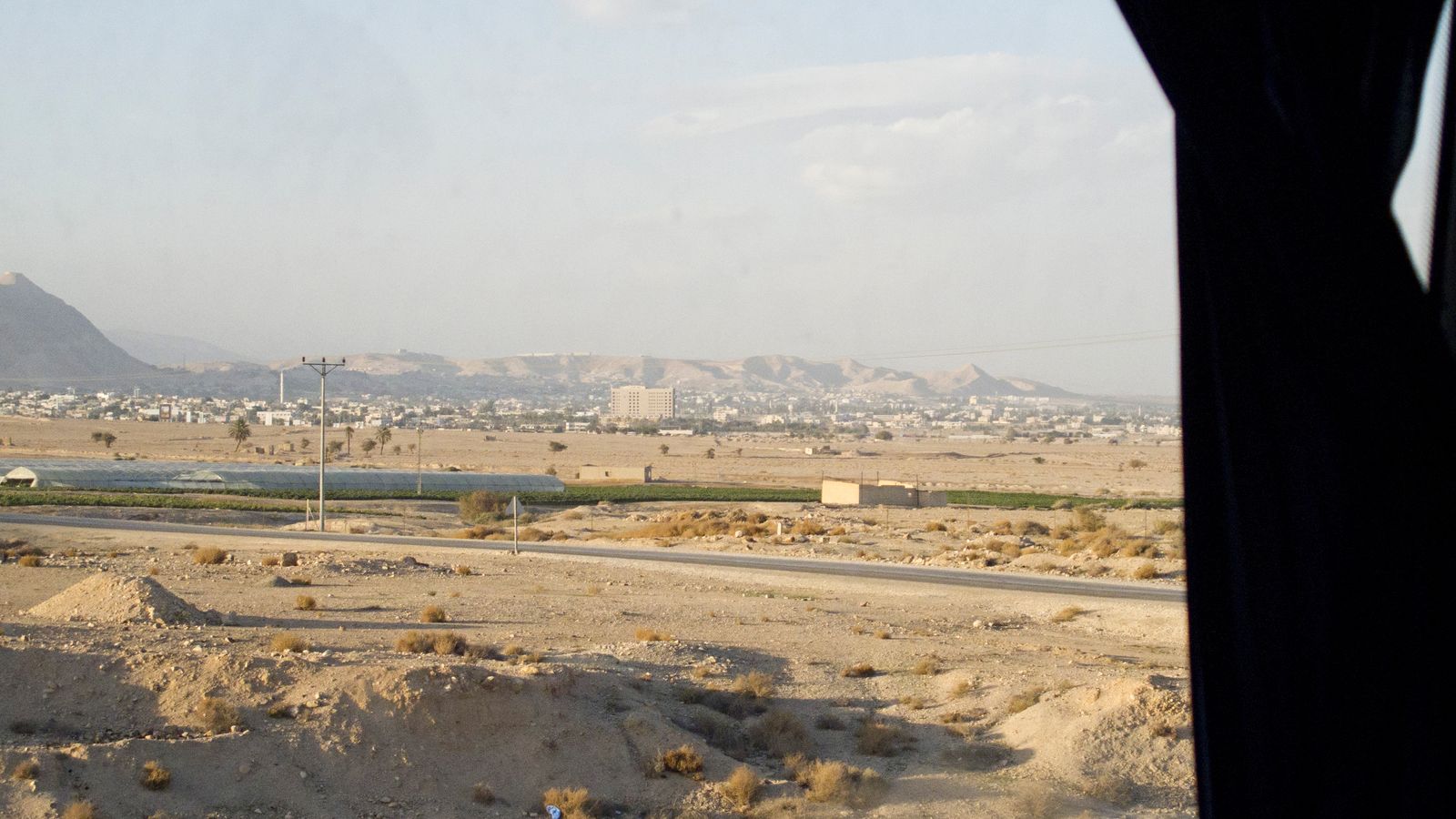
Snap question: what do the Hebrew Bible, the Christian Old Testament and the hit Coolio song ‘Gangsta’s Paradise’ have in common?
Take a moment; we’ll wait.
The correct answer is the reference to ‘walking through the Valley of the Shadow of Death’, mentioned in both the opening verse of the song, and in Psalm 23 of the Christian and Jewish holy texts, alternately as Psalm 22 in Greek and Latin versions of the Old Testament.
Key Takeaways
- The Valley of the Shadow of Death, mentioned in Psalm 23, is believed to be Wadi Qelt near Jericho.
- Jericho is one of the oldest continuously inhabited cities, with walls dating back to the Neolithic period.
- Jericho is frequently referenced in the Bible, appearing 64 times in the King James Bible.
- Jericho’s economy struggles with water scarcity, agricultural decline, and reliance on tourism and international aid.
- Despite its rich history, Jericho faces modern challenges including violence and economic instability.
It is believed that the Valley of the Shadow of Death refers to Wadi Qelt, a rocky gorge in the West Bank, which lies about 4 kilometres west of the town of Jericho.
Despite being a relatively small city of less than 30,000, Jericho can lay claim to one of the longest and richest histories of any city in the world, and is often held as among the oldest cities in the world.
Let’s explore.
How Old is Old?
So, first, some clarification.
There are lots of places which lay claim to the title of the oldest continuously inhabited place in the world. In many cases, there is solid evidence for this — take the Burrup Peninsula in northwestern Australia, also known natively as Murujaga. The peninsula features rock art determined to be at least 40,000 years old.
If the oldest place on earth is to be understood as a site where the oldest evidence of human habitation of some kind is to be found, then it would not be Jericho, and could convincingly be Murujaga. And if the world’s oldest place is to be understood instead as where the oldest man-made structures are to be found — then, equally, that would not be Jericho. It could be Tell Qaramel in modern-day Syria, where structures dating back about 12 thousand years remain standing.
Candidates for the oldest site in the world are also sometimes seen as Gobekli Tepe in modern-day Turkey, and Mureybet, an ancient settlement also located in northern Syria, both of which feature structures around 11 thousand years old.
But the continuous inhabitation of these locations are all in doubt. Not much is known about the early history of the native people of Murujaga — the Jaburara — and these, sadly, became extinct in the area following a series of settler massacres in the 19th century. Tell Qaramel, Gobekli and Mureybet are all ruins, having been free of permanent habitation for centuries and largely unknown — save for some nearby populations, perhaps — until excavation in the 1900s. As a side note, this — in theory — means that the oldest site in existence may not even be discovered, with all three of these latter sites having re-emerged only within the last hundred years, while being thousands of years old.
With all this uncertainty, the oldest place on earth is a title which remains disputed — with compelling claims supporting places as far removed from one another as China, North Africa, Oceania, and the Middle East. These feature places so old that their history is — to some degree — unknown and probably unknowable: it cannot be definitively concluded whether they remained inhabited throughout all that time or just founded, abandoned, revived, abandoned again, and revived once more.
So with so many ancient sites having an obscure history by virtue of just being that old, it is hard to define a metric by which the continuous existence of a place can be judged. But there is perhaps one criterion that could be used: the presence of a defensive wall around the exterior of a settlement.
The building of a wall is a significant development in the foundation of any settlement, especially during the Age of Antiquity and before. It represents the fact that the inhabitants of the settlement site had no intention of moving anywhere else, as could otherwise be the case — and likely was — for inhabitants of many ancient sites, with some civilisations migrating elsewhere or disappearing due to factors such as drought, occupation, famine, natural disaster, or their simple destruction.
And while the walled perimeter may not be a metric accepted by everyone, there have been a number of lists published identifying candidates for the status of the world’s oldest place. Jericho features on practically all of them.
As mentioned by TimeOut, whenever the world’s oldest cities are discussed, Jericho is never far from the conversation — having been continuously inhabited for over 11 thousand years. Its walls date from roughly the Neolithic period, being constructed around 8,000 years BCE — although, like with some other places, there is evidence of human habitation in the area a thousand years still before this.
And unlike other ancient sites, many of them now uninhabited or with only very minor populations, Jericho — today — is very far from abandoned. It is a thriving city of about 21,000 people, with most of its ancient sites intact and visitable.
Jericho and the Bible
Jericho features multiple times in Jewish and Christian holy texts.
The city is mentioned about 64 times in the King James Bible, the modern English version of the Bible, used by the Church of England since the 1600s. It is the third most-often referenced city, after the holy city of Jerusalem and the ancient — but abandoned — city of Babylon. Much reference to Jericho is made in the Old Testament, based primarily on the Hebrew Bible, in which it is often referred to as the ‘city of palms’.
The Old Testament names Jericho as the first city conquered by Israel after crossing the Jordan River and occupying the biblical Promised Land. In the Book of Numbers, written about 2,600 years ago, Jericho is described as a powerful Canaanite fortress used as a reference point by Moses as the Jews wandered the wilderness of the Sinai. In the New Testament — based on the accounts of the disciples of Jesus — Jericho is again mentioned, as the place of a miracle performed by Jesus when he restored sight to the blind beggar Bartimaeus.
Jericho itself is not directly mentioned in the Quran — the Holy Book of the Islamic faith — but neither is Jerusalem and instead both cities are seen to be indirectly referenced through specific sites located within or nearby both. Many local Muslims believe Nabi Musa, a shrine located about 11 kilometres south of modern-day Jericho, to be the tomb of Moses, something thought to have been revealed in a dream to the 12th-century Muslim leader Saladin — although Islamic theology declares the actual site of Moses’ tomb to be unknown.
A Tale of Many Conquests
After having been occupied by both the Roman and Byzantine civilisations, the city came under Muslim conquest in the 7th century, during which time it became referred to with its contemporary name in Arabic, Ariha.
In addition to many existing Jewish and Christians sites of note in the area, one of the most important sites belonging to early Islamic history is located close to Jericho. Hisham’s Palace, built by the Umayyad civilisation in the 8th century, is located about 3 kilometres north of Jericho city. Although destroyed in an earthquake only twenty years after being built, the sprawling mosaics of the palace were uncovered intact in the 1930s, and are today in process of restoration by way of a 12 million dollar donation by Japan. Seismic activity would remain a potent risk for Jericho and the wider Levant, and deadly earthquakes would strike again throughout the centuries, wreaking havoc to both human habitation and the historic riches of the region.
Watch The Project Briefing
Open Video
Video Briefing
Jericho: The Oldest City on Earth?
Following a brief conquest by the Crusaders in the 12th century, the city returned to Arab rule before becoming part of the Ottoman Empire in 1517. Although the city had become almost uniformly Muslim by now, the reign of Suleyman the Magnificent saw the return of Jewish communities to what would later be known as Palestine, a trend which would only increase at the end of the Ottoman era and with the establishment of Mandatory Palestine.
Ottoman control over Palestine lasted until 1917, when it was dispossessed during the First World War. It soon came under the control of Britain, under the terms of a 1920 proposal by the League of Nations known as the British Mandate for Palestine. The mid-war Balfour Declaration also promised a homeland in Palestine to the Jewish community in Europe, in an attempt to rally their support for the war effort. This saw Jewish immigration to Palestine rise exponentially in the 1920s, contributed to by rising antisemitism in Europe.
The new arrivals did not really get on with the local Arab population, resulting in massacre after massacre in the years following the beginning of the Mandate. Jericho, being largely free of mixed settlement, was — like Gaza — spared from such episodes of violence in the 1920s, but that did not mean it escaped destruction of any kind. In 1927, a strong earthquake shook Palestine and Transjordan, killing around 400 people, and levelling multiple buildings in Jericho, which lay close to the quake’s epicentre. By this time, the city was both poor and tiny, having a population of a little under 2,000 people in 1938 — predominantly Muslim Arabs, alongside a handful of Christian Arabs.
Recent History
Following the end of the Palestinian Mandate and the resulting Arab-Israeli War, Jericho fell into the hands of the state of Jordan, who claimed rulership of an area which became known as the West Bank. Jericho grew in size, having absorbed many Palestinian refugees fleeing from what was now the modern state of Israel, reaching around 10,000 inhabitants in 1960.
The Jordanian administration continued until 1967, when the Six-Day War saw Israel sweep into the West Bank, the Gaza Strip and the Golan Heights. Jericho was now under Israeli control.
A rapidly-conducted Israeli census the same year determined Jericho’s population to have fallen to 7,000 people, as many of the displaced Palestinians from the 1948 war fled once more to other parts of the West Bank, to Jordan, or to Syria.
Jericho and the West Bank remained under Israel’s direct control until 1994, when it fell under the administration of the newly-established Palestinian Authority with the signing of the Oslo Accords. The first Oslo Accord was followed by the so-called Gaza-Jericho Agreement, under the terms of which Israel promised to partly withdraw from the Jericho region and the Gaza Strip. Resultantly, Jericho became the first Palestinian city transferred to the control of the PA.
However, Israel had spent the intervening years between 1967 and the signing of the Oslo Accords building a wide variety of settlements and outposts which now dotted the West Bank landscape, and which would remain under the direct control of Tel Aviv. Jericho, being relatively isolated in the southeast of the West Bank alongside the River Jordan, found itself surrounded by settlements outside its control, hampering the movement of its inhabitants.
A Troubled Peace in the City of Palms
In 2020, the UN voted to make Jericho a UNESCO World Heritage site, owing to its vast history and many historical treasures. However, the decision was contentious, being seen by Israel as a provocation. Israel cut ties with UNESCO only the previous year, resulting in both that the vote came at a very contentious moment, and that the city had very little chance of benefiting from its new status.
In 2024, the ancient city of Jericho remains part of the West Bank and controlled by the Palestinian Authority. And while the city has remained relatively at peace — at least when compared with cyclical violence in other cities in the West Bank and especially the Gaza Strip — that does not mean that all is rosy.
Jericho itself is almost uniformly Arab Muslim, and its population has risen to above 20,000. It is capital of the Jericho governorate, one of the West Bank’s administrative divisions with a population of around 50,000 people, of whom around 14,000 live in refugee camps.
But today, Jericho is surrounded on three sides by Israel settlements: Na’omi (around six kilometres to its north), Almog (six kilometres to the south), and Vered Yeriho, which is practically touching Aqabat Jabr, a refugee camp southeast of Jericho, with both of them located adjacent to the Wadi Qelt or the biblical Valley of the Shadow of Death. Further south and north are several more Israeli settlements, and practically the entirety of the thirty-kilometre route between Jericho and Jerusalem runs through yet more Israeli settlements still — including the 40,000-inhabitant Ma’ale Adumim — before reaching Palestinian-majority East Jerusalem.
To Jericho’s east lies the River Jordan, separating the West Bank from the state of Jordan by both a natural boundary and by one of the most stringent borders in the world, prone to occasional cross-border skirmishes and regular closures by Israel.
And the ancient city of palms, despite being largely an oasis of peace for most of the turbulence of the last few decades — at least, when compared with flashpoint sites in the West Bank such as Jenin and Nablus — has seen an increase in violence in recent years. The Aqabat Jaber refugee camp — in particular — has been the site of repeated instances of alleged militant activity and Israel Defence Force incursions, and Jericho as a whole has seen recent instances of intercommunal fighting, detentions, home demolishments, and killings.
And perhaps an equally potent problem is posed to Jericho on an economic front.
The city and surrounding area struggles with a weak economy, water scarcity and overconsumption, which — together with land loss due to settlement construction — have all contributed to a sharp decline in traditional agriculture, the city’s lifeblood for millennia. According to a paper published by the International Journal of Urban Policy and Planning, the lack of water — in particular — has been a particularly biting problem, contributed to by the redirection of some surrounding water sources away from Jericho’s agricultural works to the new surrounding settlements.
This problem is likely to only get worse as climate change causes droughts in the area to become more severe, and the paper also pointed out that the terms of the Oslo Accord allowed residents of PA-controlled areas to construct water wells only 150 metres deep, but those in Israel-controlled settlements had no such restrictions and could therefore access deeper reservoirs underground.
With its agricultural prospects floundering, Jericho is reliant on tourism and international donations to remain afloat, both of which can be irregular and impacted by explosions of violence in other parts of Palestine and Israel. This makes city planning exceedingly difficult to budget. Jericho is also indirectly dependent on import duties which the PA as a whole relies on, but these are collected by Israel and therefore subject to withdrawal in times of strife, choking its economy further. Given Jericho’s high rate of historic and religious tourism, it has a lower rate of unemployment than the West Bank as a whole, but this remains nonetheless high — at around 15% in 2020, against a State of Palestine figure of almost 26% the same year.
So it may be that the land of the Valley of the Shadow of Death, the ancient site of many biblical miracles, may — without consistent investment and greater stability — dry out in the sun, and flounder under the weight of the tragic developments taking place nearby.
Despite its many cultural riches — Jericho could become a place devoid of prospects, and in need of a modern-day miracle of some kind once more.

Simon Whistler
Simon Whistler is one of YouTube's most prolific educational creators, with tens of millions of subscribers across his channels. Places is his expedition into the world's most remarkable locations — from cities carved from salt to islands nobody dares inhabit. He brings a researcher's rigour and a traveller's awe to every field note.
Frequently Asked Questions
What is the significance of the Valley of the Shadow of Death mentioned in the article?
The Valley of the Shadow of Death refers to Wadi Qelt, a rocky gorge in the West Bank, which lies about 4 kilometers west of the town of Jericho. It is mentioned in both the opening verse of the song ‘Gangsta’s Paradise’ by Coolio and in Psalm 23 of the Christian and Jewish holy texts.
How old is Jericho and what makes it significant?
Jericho is believed to be one of the oldest cities in the world, with a history of continuous inhabitation for over 11,000 years. Its walls date from roughly the Neolithic period, constructed around 8,000 years BCE. Jericho is often considered among the oldest cities due to its defensive walls, which indicate long-term settlement intentions.
What are some of the other ancient sites that claim to be the oldest continuously inhabited places?
Other ancient sites that claim to be the oldest continuously inhabited places include the Burrup Peninsula in northwestern Australia, Tell Qaramel in modern-day Syria, Gobekli Tepe in modern-day Turkey, and Mureybet in northern Syria. However, the continuous inhabitation of these locations is often disputed.
How is Jericho mentioned in the Bible?
Jericho is mentioned about 64 times in the King James Bible. It is described as the first city conquered by Israel after crossing the Jordan River and occupying the biblical Promised Land. In the New Testament, Jericho is mentioned as the place where Jesus performed a miracle by restoring sight to the blind beggar Bartimaeus.
What is the significance of Hisham’s Palace in Jericho?
Hisham’s Palace, built by the Umayyad civilization in the 8th century, is located about 3 kilometers north of Jericho city. It is one of the most important sites belonging to early Islamic history, featuring sprawling mosaics that are currently being restored.
What is the current political status of Jericho?
As of 2024, Jericho remains part of the West Bank and is controlled by the Palestinian Authority. It is surrounded by Israeli settlements and faces economic and political challenges, including water scarcity and land loss due to settlement construction.
What are some of the economic challenges faced by Jericho?
Jericho struggles with a weak economy, water scarcity, and overconsumption, which have contributed to a decline in traditional agriculture. The city relies on tourism and international donations, but these can be irregular and impacted by violence in the region. Additionally, Jericho is indirectly dependent on import duties collected by Israel, which can be withdrawn in times of strife.
What is the significance of the Oslo Accords for Jericho?
The Oslo Accords, signed in 1994, transferred Jericho to the control of the newly-established Palestinian Authority. However, the terms of the accords allowed residents of PA-controlled areas to construct water wells only 150 meters deep, while those in Israel-controlled settlements had no such restrictions, exacerbating water scarcity issues in Jericho.
What is the current population of Jericho?
As of the article, Jericho has a population of about 21,000 people. It is the capital of the Jericho governorate, which has a population of around 50,000 people, with around 14,000 living in refugee camps.
What is the significance of the Aqabat Jaber refugee camp in Jericho?
The Aqabat Jaber refugee camp, located southeast of Jericho, has been the site of repeated instances of alleged militant activity and Israel Defence Force incursions. It is practically touching the Israeli settlement of Vered Yeriho, contributing to the complex political and security dynamics in the region.
Sources
- Original Places video: Jericho: The Oldest City on Earth?
- https://www.britannica.com/place/walls-of-Jericho
- https://www.nationalgeographic.com/travel/article/oldest-sites-world
- https://www.timesofisrael.com/one-of-worlds-largest-mosaics-unveiled-at-jericho-desert-castle/
- https://www.timeout.com/travel/oldest-cities-in-the-world
- https://reliefweb.int/map/israel/jewish-settlements-west-bank
- https://www.islamiclandmarks.com/palestine-other/maqam-of-musa-as
- https://www.jewishjericho.org.il/english/thoughts/VisitingTheCityofJericho-en.html
- https://biblescripture.net/top-10-most-frequently-mentioned-cities-in-the-bible-their-significance/
- https://time.com/archive/6887340/the-middle-east-bloody-frontier/
- https://edition.cnn.com/2023/05/30/middleeast/jericho-west-bank-refugee-camp-intl/index.html
- https://www.sciencedirect.com/science/article/pii/S0264275124005523#s0040
- http://www.pipa.ps/page.php?id=23b284y2339460Y23b284
- Hero image source by Dan Lundberg / openverse, by-sa.