

Have you ever watched Fiddler on the Roof?
If you’ve seen the 1971 musical classic, you’ll be familiar with the whimsical life of Tevye in the tight-knit town of Anatevka. You’ll recall how Tevye struggled to eke out a living as a dairyman, within a Jewish community itself struggling beneath the yoke of Imperial Russia. You’ll remember the traditions so important to him and his wife, and the close bond between the family and their neighbours.
What you’ll have been looking at was life in a Shtetl — Jewish settlements once common across Central and Eastern Europe in what was historically known as the Pale of Settlement — until the Second World War.
Key Takeaways
- Qirmizi, Azerbaijan, is the last remaining Shtetl, preserving Jewish life from pre-World War II Europe.
- The village, known as the Red Village, is home to a tight-knit Mountain Jewish community.
- Qirmizi contrasts with typical Shtetls by having a significant population of billionaires.
- The village’s economy struggles, leading many young people to leave for better opportunities.
- Qirmizi’s future is uncertain, with hopes for tourism to revitalize the declining population.
And with the Second World War, this way of life died. Most of the inhabitants of such villages were slaughtered, and the survivors wound up either integrating into surrounding societies or emigrating away. What remained of the Shtetl way of life went with them.
But not entirely.
There remains one village where this way of life is preserved. One where the tight-knit community of Jews lives on as it has done for centuries, in a manner once common in Europe.
And it is found…in Azerbaijan.
The Red Village
The world’s last Shtetl does not — at first glance — look anything out of the ordinary.
Officially known in Azerbaijani as “Qirmizi Qesebe” or simply “Qirmizi”, the settlement is located in the Caucasus Mountains, around 180 kilometres north of Azerbaijan’s capital Baku, and less than 40 kilometres from the border with Russia. Qirmizi Qesebe is more commonly referred to by its Russian name, ‘Krasnaya Sloboda’, with both names translating to English as ‘Red Village’ — a nod to the Soviet Union, under which the settlement’s name was changed from ‘Yevreyskaya Sloboda’, or ‘Jewish Village’. But the name could easily — as some have surmised — also be a reference to the prominent red roofs which adorn the village skyline.
Other than this, there isn’t much which appears to visibly separate Qirmizi from any other struggling village in the poor, rural provinces of the Caucasus. It has the same nondescript buildings, and a withering population peaking at around 3,500, significantly less than its height of 18,000 in 1991. It is thought that much of its population resides in the village only seasonally, with the population falling to as low as 500 permanent residents in the winter months. The general profile of Qirmizi also largely resembles that of surrounding settlements in other ways too. Village elders pass their time in the local chaykhanas — or traditional Azeri tea houses — often playing backgammon, a common pastime across the Caucasus. The village is dotted by a few former factories, now in disuse after the passage of time saw their industries decline.
But the first key distinction is in the demographic profile. In contrast to the region’s Shia Muslim majority, the locals of Qirmizi overwhelmingly belong to the so-called Mountain Jewish community, a subgroup of Mizrahi Jews which is believed to number up to 50,000 people in Azerbaijan, and some 150,000 in Israel. The Mountain Jews have a presence in present-day Azerbaijan going back 1,000 years, although many arrived during waves of persecution in Iran during the 18th century, at which time the village was established.
To this day, the population of the village speak Juhuri or “Judeo-Tat”, a member of the Iranian branch of languages related to Persian and, especially, to a language spoken by another minority in Azerbaijan, known as Tat. Perhaps due to the close relation between the two, it is said that Jews in the North Caucasus city of Nalchik managed to survive Nazi occupation by pretending to belong to the Tat community, and successfully concealing their true identity.
And knowledge of other languages is also common, as a means of communication not only with outsiders, but also between the Mountain Jewish majority and small Georgian Jewish and Ashkenazi populations — both of which arrived in the town in the 19th and 20th centuries. The collective Jewish population of Qirmizi live a largely undisturbed existence, in peace with other local ethnicities — many of whom belong to either the Tat or Lezgin minorities — in addition to the wider Azeri majority.
But if you look a little closer, there are a few other ways by which Qirmizi contrasts starkly from the village and ethnicities which surround it. One of those is a quite spectacular mountain of wealth — but we’ll get to that in a little bit.
The Shtetl Life
Now, one of the things that made living in a Shtetl different from any other type of settlement was not so much its buildings or physical features, but more so its culture, something equally true of Qirmizi as of the prewar European Shtetls.
The Shtetl way of life was eloquently described in the writings of Sholem Aleichem, a nineteenth- and early twentieth-century Jewish writer hailing from what is now Ukraine. In Tevye and his Seven Daughters (Aleichem’s story which was later adapted for the stage as ‘Fiddler on the Roof’), the principal character resides in the village of Boyberik — today known as Boyarka — a Jewish-inhabited settlement on the outskirts of Yehupetz, which was in turn a semi-fictionalized rendering of Kyiv. In other words, the shtetl existed side-by-side with a major non-Jewish urban settlement, with whose inhabitants the Jews interacted regularly, often for commercial reasons. The same is more or less true of Qirmizi, which lies adjacent to the town of Quba, the principal city of the Quba district of Azerbaijan, with the two settlements located on opposite banks of the Kudyal river.
And like Boyberik — whose inhabitants earned a living as labourers and artisans — the traditional industries of Qirmizi also historically centred around craftsmanship. Carpet weaving is a common traditional activity in the Quba area generally — something which is no different in its outlying shtetl.
For centuries, the populations of European Shtetls predominantly spoke their own language — which for Ashkenazi Jews was Yiddish, a derivative of medieval German. For the Mountain Jews, this is the aforementioned Juhuri dialect still in use by many. Still, many European Jews would have been competent in the predominant language of commerce of the areas they lived in — often Russian or German — and this, again, is no different in contemporary Qirmizi. Most locals speak Russian, which — especially during the Communist era — was the lingua franca used for interethnic communication by communities across the Soviet Union. As described by The Times of Israel, the use of Russian in the village surpasses the use of Azerbaijani even to this day. Even so, some inhabitants are trilingual, speaking competent Azerbaijani and Russian, as well as their native Judeo-Tat.
Historically, the Ashkenazi Jews in Europe lived a mostly piecemeal existence, being cyclically banned from merchanting and other professions by discriminatory laws, and being precluded from yet others by their own faith. This helped cultivate an integral and self-sufficient community punctuated by the influence of religion. Well just like in European Shtetls, the Mountain Jews adhere strongly to traditional Jewish customs.
Little business is conducted on Saturdays — the Jewish Sabbath — and prayer times are strictly observed. Endogamy — or marriage within the community — is predominant, divorce is regarded as a tragedy and is very rare, and Qirmizi even has its own matchmaker — who was also the village postman.
The Jerusalem of the Caucasus
In 2020, Orthodox Jewish vlogger Shloime Zionce paid a visit to Qirmizi Qesebe.
While the Orthodox movement — something born largely out of Ashkenazi Judaism — was not especially prevalent amongst the local population in their routines and attire, what Zionce found was a community nonetheless keenly adhering to its Jewish faith.
Morning prayers — or Shachras — could be observed in one of the many synagogues in the town — as could Jewish traditional education at both the village Yeshiva and its Beit Midrash, or study hall. The village also features a mikvah or ritual bath complex, in addition to a wedding hall and a museum dedicated to the history of the Mountain Jews. On a hilltop above Qirmizi, several cemeteries with gravestones marked in Hebrew overlook both the Red Village itself and its sister town Quba, on the other side of the river.
Given its unusual status as a Shtetl which outlived not only the passage of time, but the threat of the Nazis and the restrictions of the Soviet era, Qirmizi has been the focus of great intrigue by Jewish communities abroad. Suppression by the Soviets saw local rabbis sent to gulags, and all remaining religious expression forced into secrecy. As a result, by the time communism fell, the spiritual devotion of the locals was at an all-time low, and so Jewish clerics — especially those belonging to the Orthodox Chabad sect — have since been sent by authorities in Israel to steer the flock back towards their traditions. But outside influence has seen form in other ways too.
The synagogues have been refurbished, and other religious institutions in Qirmizi have also been established or renovated. Generous donations from wealthy benefactors from the Mountain Jewish community in Russia have allowed the regeneration of the village. The village has received support from the Azerbaijani government and also from Lev Leviev, an Israeli businessman and diamond magnate, and major benefactor of the Chabad movement. Leviev also became well-known when con artist Shimon Hayut pulled on his surname and earned infamy as the Tinder Swindler, but his charitable donations have helped upkeep ailing Jewish communities abroad, with Qirmizi amongst them.
A Shtetl Like Any Other (But Not Quite)
Now, as you will have gathered, the features of life in Qirmizi — in many ways — quite obviously resemble the Shtetls of old. But there are two areas in which this Shtetl — and the people who come from it — are quite radically different.
Watch The Project Briefing
Open Video
Video Briefing
Red Village: The Last Shtetl in the World.
For one thing, Qirmizi has a strong military history. Like many other communities in the Caucasus, the Mountain Jews were ready to take up arms to defend themselves in the case of an external threat. This somewhat contrasted the community with the Ashkenazim of Europe, who were often forced to adopt a more pragmatic approach towards the world around them, and who generally chose neutrality as conflicts in Europe raged.
While European Jews did participate individually in such conflicts — and often with distinction — a unified military front was largely eschewed to ensure survival across centuries of routine upheaval. But when the Second World War found its way to the Caucasus, as many as 500 village boys from Qirmizi joined the ranks of the Soviets to fight the Nazis. Of these, only 200 returned.
More recently, a member of the community received the honour of National Hero of Azerbaijan, for his role as a tank driver in the First Nagorno-Karabakh War. Albert Agarunov was killed by sniper fire on the front in 1992, while attempting to recover the bodies of his comrades during the fall of Shusha. A bronze statue was later erected in Baku in his honour, in the wake of the successful Azerbaijani offensive which reclaimed most of the same territory.
Other Mountain Jewish community figures became the subject of deliberate focus by the Azerbaijani media during the same conflict. This included David Sadiyev, a soldier who was profiled in several state news pieces, and Rabbi Zamir Isayev, who publicly declared his pride in the dozens of Jewish soldiers serving with the Azerbaijani army.
But the second — and today, more significant — distinction is on an economic front.
You see, impoverishment was a common feature of Shtetls across Europe before the war. As mentioned, the Jewish populations were largely tradespeople, artisans, carpenters and small-time traders. Many wouldn’t have worked on Saturdays, and some young men would devote themselves — above all — to full-time study of the Torah. Added to that were the discriminatory practices to which they were subjected, and that the Jews were often made to establish their communities on fallow and unproductive parcels of land, which rendered agriculture difficult.
Unsurprisingly, the Shtetls were often rife with poverty.
Well, this is a little different in Qirmizi Qesebe.
It’s not that all the village people are particularly wealthy. But what does make the village highly unusual is the population of billionaires who originated from there.
God Nisanov was born in Qirmizi and — like many from his community — pursued further education in Baku. He later opened a consignment shop in his native village, before moving to Russia where he made his fortune. Today, Nisanov is one of the wealthiest people in the world, with an estimated fortune of 3.1 billion US dollars, according to Forbes.
He’s not the only one. Nisanov gained his wealth through business interests initially in the field of real estate, alongside his partner and fellow Qirmizi native, Zarakh Iliev. Iliev, like Nisanov, is estimated to have a personal fortune above 3 billion dollars. And if two billionaires from a town which barely tops three and a half thousand people weren’t enough, German Zakharyayev is another local who made it big in Russia.
Zakharyayev arrived in Russia in 1992, and made his fortune in trade with his brothers. Along with his childhood friends Nisanov and Iliev, Zakharyayev is believed to belong to the world’s 3,000 or so billionaires.
But the recent generation of so-called “Quba Jew” billionaires is still not necessarily unique. Before Nisanov, Iliev and the Zakharyayevs, a Qirmizi family known as the Gilalovs also made it big in Russia, largely in commerce and construction. The family business was started by patriarch Talhum and later led by his sons Zaur and Akif Gilalov, who collectively also founded STMEGI, the International Charitable Foundation of Mountain Jews.
This — in theory — would offer Qirmizi the twin distinction of being not only the last remaining Shtetl, but also one of the locations with the greatest concentration of billionaires in the world.
As a local resident joked to Israeli newspaper Haaretz:
The town is 1 kilometer long. It is probably the richest kilometer in the world.
The Billionaires’ Shtetl
All three Qirmizi billionaires are active in Jewish affairs, and the cumulative influence of the sons of the Red Village has led to an outsized presence of the Mountain Jews in major Jewish organisations.
God Nisanov was elected Vice President of the World Jewish Congress in 2014, and left the position eight years later, after the U.S. placed him on a sanctions list. Zakharyayev is Vice-President of the Russian Jewish Congress, on whose board Nisanov also sits as a member. And Zakharyayev, Nisanov, and Iliev alike have all contributed to the establishment or restoration of Jewish schools, synagogues and other cultural institutions in Russia.
German Zakharyayev is currently President of the International Charitable Foundation of Mountain Jews, founded and initially led by founder Zaur Gilalov, but who was murdered in Moscow in a suspected business-related killing in 2004.
The eminence of the tycoons has benefited their home village in several ways. Iliev and Nisanov helped establish the aforementioned Museum of Mountain Jews, which opened in Qirmizi in 2020. Several new mansions have been constructed in the place of older village houses, and synagogues and schools have seen quite extraordinary improvements.
In his visit to the village, Shloime Zionce noted the splendid interior of the Synagogue, despite its flock visibly only amounting to a small handful of worshippers. According to Zionce, this particular synagogue was also only in use during the barren winter months, and a much larger synagogue would be used in the summer months when the population increased. He noticed the splendid Persian carpets which cloaked the Winter Synagogue’s interior, of which he counted fifteen and revealed each one cost around 2,000 dollars.
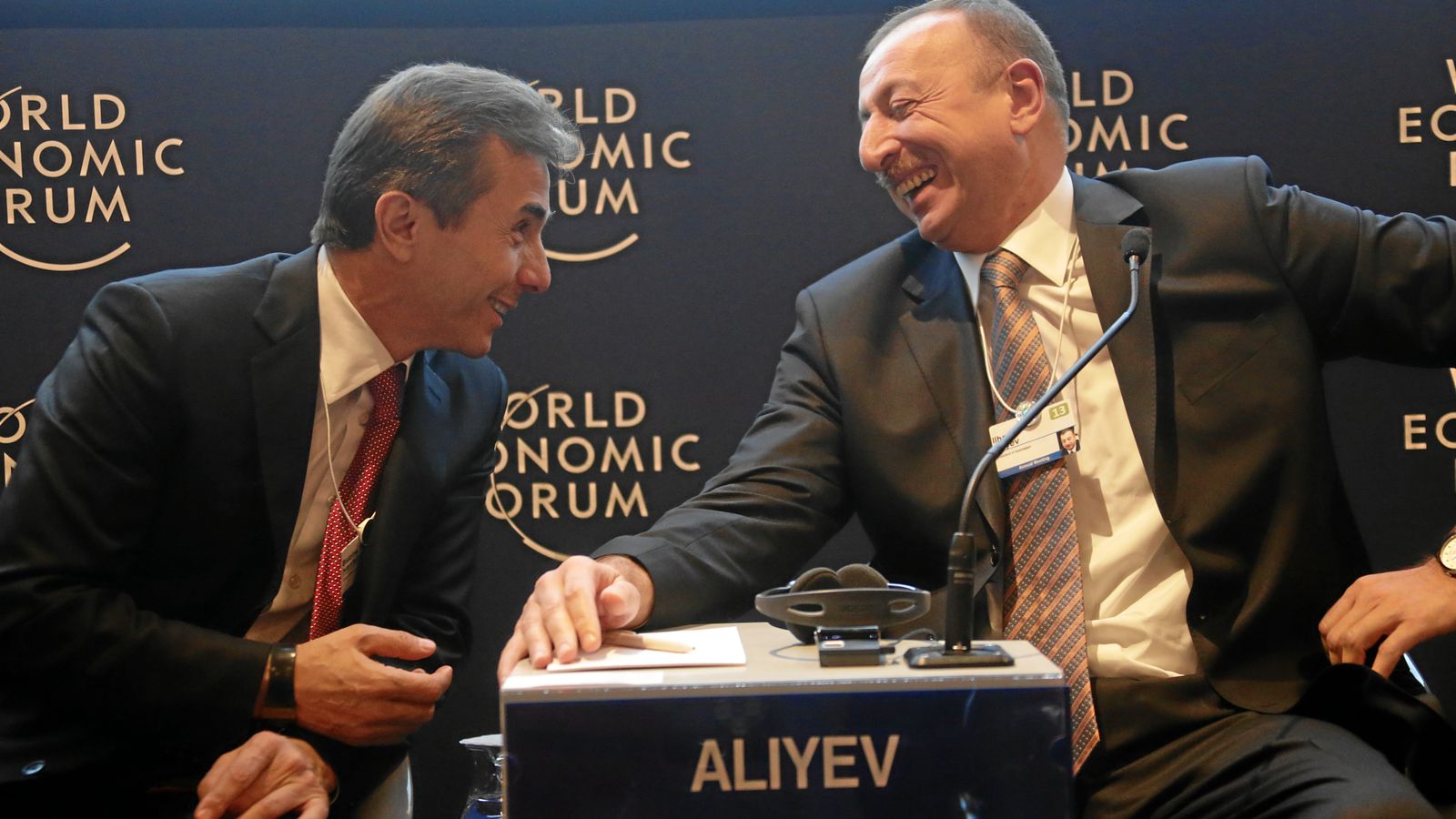
The Qirmizi billionaires have erected mansions in their hometown, which have welcomed some rather noteworthy names to the small and unassuming village. Among those who’ve paid a visit to the Shtetl in recent years include Patriarch Kirill, Primate of the Russian Orthodox Church, as well as Azerbaijan’s President Ilham Aliyev, Israeli playwright Iddo Netanyahu (brother of Benjamin), and famous Turkish singer Ibrahim Tatlises, who arrived to perform a private concert at the birthday of one of the billionaires’ sons.
The illustrious connections of its natives also play a role in safeguarding the high status of the community. The close ties of the Quba billionaires to authorities in Russia and Azerbaijan’s authoritarian President have led to investments benefitting the settlement’s schools and other infrastructure. And the contentment of the locals has in turn paid dividends to Aliyev, being able to hold up the Mountain Jewish community as an example of tolerance in what is otherwise one of the region’s most repressive states. Through the favourable discourse of Azerbaijan’s Jews, Aliyev has managed to draw attention away from often extreme state rhetoric against Armenians and — to a lesser degree — against the Talysh, a Persian ethnic group who’ve long complained of discrimination and the suppression of language and cultural rights. As described by Israeli media outlet Haaretz:
Sponsoring and supporting its small and unthreatening Jewish community — particularly with the aid of the region’s wealthy Jewish businessmen — is a key part of advancing the narrative (…) that Azerbaijan is a tolerant and anti-Semitism-free country fighting for its survival.
The same narrative has also contributed to the military ties between Israel and Azerbaijan, which procured and used Israeli arms in its successful assault on the breakaway region of Nagorno-Karabakh in 2020.
An Uncertain Future
Yet despite its relative grandeur and polish, the future of Red Village is uncertain.
Extreme wealth of some of its natives to one side, Qirmizi and the surrounding area are not abundant with economic prospects, and many young people leave the village for life in bigger cities or abroad — understandably so, given the path trodden by their forebears in Russia. Qirmizi’s economic turmoil is something it shares with many villages and towns nearby. The once-prominent textile industry in Quba has collapsed, factories have shut, development funds have been divested away, and many of the rich and wealthy have moved to Baku.
The main inhabitants of the Shtetl are now the elderly and young children. Aside from Russia, Qirmizi’s inhabitants have left for Israel and the United States, in particular the Mountain Jewish enclaves in Brooklyn and the Mediterranean city of Tyre. Many of these send remittances back to their hometown, and periodically return in the summer season. Even so, the permanent population continues to decline, as it has done consistently since the fall of the Soviet Union.
And with a weak local economy and few jobs, those who remain are largely dependent on family and benefactors abroad.
This must be a bitter reality, given that Qirmizi remains a village of great illustriousness. Aside from its native billionaires and the famous soldier Albert Agarunov, the town is renowned for being the home of other figures including physician Gavriil Ilizarov — who pioneered several advances in reconstructive surgery — as well as no less than seven recipients of the prestigious Hero of Socialist Labour, which was issued during the Soviet Era.
But its standing and recent features do not change reality. Jobs remain sparse, and while the Museum of the Mountain Jews and a newly-built visitor centre are welcome additions, as pointed out by one local resident, the two sites collectively employ only five people.
As the profile of the world’s last Shtetl increases and curious visitors arrive, there is a possibility that Qirmizi’s decline may be stayed by tourism. Such is the hope of many locals. But if not, the village may follow its predecessors in Europe into obscurity, its young population left in search of greener pastures, and a receding settlement left in its wake.
The Red Village left rusting in the Caucasus.

Simon Whistler
Simon Whistler is one of YouTube's most prolific educational creators, with tens of millions of subscribers across his channels. Places is his expedition into the world's most remarkable locations — from cities carved from salt to islands nobody dares inhabit. He brings a researcher's rigour and a traveller's awe to every field note.
Frequently Asked Questions
What is the Red Village?
The Red Village, officially known as Qirmizi Qesebe or Qirmizi in Azerbaijani, is the last remaining Shtetl in the world. It is located in the Caucasus Mountains, around 180 kilometers north of Baku, Azerbaijan.
What is a Shtetl?
A Shtetl is a small town with a large Jewish population, historically common across Central and Eastern Europe. The term is often associated with the Jewish communities that lived in these towns before the Second World War.
How did the Red Village survive the Second World War?
The Red Village survived the Second World War due to its remote location in the Caucasus Mountains and the fact that it was part of the Soviet Union, which had a different experience of the war compared to Eastern Europe.
What languages are spoken in the Red Village?
The primary language spoken in the Red Village is Juhuri or Judeo-Tat, a member of the Iranian branch of languages related to Persian. Many residents also speak Russian and some speak Azerbaijani.
What is the population of the Red Village?
The population of the Red Village peaks at around 3,500 during the warmer months but can drop to as low as 500 permanent residents in the winter.
What is the economic situation in the Red Village?
The Red Village faces economic challenges similar to other rural areas in the Caucasus. Many young people leave for better opportunities in cities or abroad, leading to a declining permanent population. The village’s economy is supported by remittances from emigrants and benefactors.
Who are some notable figures from the Red Village?
Notable figures from the Red Village include billionaires God Nisanov, Zarakh Iliev, and German Zakharyayev, as well as physician Gavriil Ilizarov and soldier Albert Agarunov, who was honored as a National Hero of Azerbaijan.
What role do the billionaires from the Red Village play in the community?
The billionaires from the Red Village have contributed significantly to the regeneration of the village, establishing and renovating religious institutions, schools, and cultural sites. They also have influential roles in Jewish organizations and maintain strong ties with authorities in Russia and Azerbaijan.
What is the future outlook for the Red Village?
The future of the Red Village is uncertain due to economic challenges and a declining permanent population. While tourism and the influence of wealthy benefactors may help, the village faces the risk of following the path of European Shtetls into obscurity.
What is the significance of the Red Village to Azerbaijan?
The Red Village is significant to Azerbaijan as an example of religious tolerance and diversity. The Azerbaijani government uses the Mountain Jewish community to promote a narrative of tolerance and anti-Semitism-free country, which also strengthens military ties with Israel.
Sources
- Original Places video: Red Village: The Last Shtetl in the World.
- https://www.travelaze.com/red-town/
- https://newlinesmag.com/essays/how-the-mountain-jews-of-azerbaijan-endure/
- https://youtu.be/tAg_gT73UPE?si=5f_meQ5ZjnKJzjfG
- https://www.atlasobscura.com/places/krasnaya-sloboda-qirmizi-q-s-b
- https://azertag.az/en/xeber/first_museum_of_mountain_jews_in_red_settlement_of_azerbaijans_guba_district-2086685
- https://www.trend.az/life/socium/3337159.html
- https://jweekly.com/2021/01/20/in-azerbaijan-patriotic-jewish-soldiers-are-poster-children-of-the-war-with-armenia/
- https://www.forbes.com/profile/god-nisanov/
- https://www.forbes.com/profile/zarakh-iliev/
- https://azertag.az/ru/xeber/nashi_sootechestvenniki_god_nisanov_i_zarah_iliev_sozdayut_v_azerbaidzhane_pervyi_v_mire_muzei_gorskih_evreev-1324141
- https://www.jta.org/2004/03/07/lifestyle/mountain-jewish-leader-killed-in-moscow
- https://www.timesofisrael.com/a-glimpse-into-azerbaijans-hidden-all-jewish-town/
- http://www.visions.az/en/news/386/ad48cd0/
- https://amnesty.ca/urgent-actions/azerbaijan-academics-face-up-to-20-years-in-prison-for-speaking-out/
- https://apnews.com/article/armenia-azerbaijan-nagorno-karabakh-weapons-israel-6814437bcd744acc1c4df0409a74406c
- https://en.wikipedia.org/wiki/Gavriil_Ilizarov
- https://en.wikipedia.org/wiki/Albert_Agarunov
- https://www.hadassahmagazine.org/2008/01/14/feature-mountain-jews-brooklyn/
- Hero image source by Remy Steinegger/World Economic Forum / openverse, by-sa.