
Russia has whole cities that you just… cannot visit. Not in the usual sense of “best not wander too close to that military base” either, but in the sense of whole places, and the lives built around them, being hidden behind a special regime of secrecy and obfuscation.
It sounds like a leftover bit of Soviet madness, doesn’t it? The kind of thing you’d think would have died alongside the hammer and sickle – hurled into the same rubbish bin as bread queues, five-year plans, and all the other wonderful quirks of that particular regime. Yet, no, here they are today, having not just survived the fall, but thrived after it – being reborn in a way that makes them far more formalised and codified than their Communist forerunners, but still every bit as essential to the functioning of the state.
But just what do they do in them? What is life like inside? How many of them are there? And how secret really is life inside of them?
Key Takeaways
- Russia has numerous ‘Closed Cities’ that are entirely off-limits to outsiders.
- These cities were initially created during the Soviet era for top-secret state purposes.
- Closed Cities are well-provisioned with amenities and consumer goods, making them desirable places to live.
- Post-Soviet Russia has formalized these cities into ‘ZATOs’ with legal definitions and benefits.
- ZATOs are crucial for Russia’s defense and aerospace activities, housing vital military and nuclear facilities.
As luck would have it, all of those – and more – are questions that we’ll be answering today, as we dive into the strange and secretive world of Russia’s so-called ‘Closed Cities’.
The Fundamentals
Let’s begin by addressing a foundational question: beyond vague notions of just ‘not being allowed in’, what actually is a Closed City?
A ‘Closed City’ is, fundamentally, still just a city – and in every sense of the word too. They have schools for the wee baby children, supermarkets so you can get in the weekly big shop, bars aplenty for getting tanked up, and parks for dogs and the doing of their poos. They are, in a sense then… perfectly normal.
And yet, despite all of that, a Closed City could actually not be any less normal, because they are, all of them, settlements with a specific primary purpose: to facilitate and support the execution of top secret matters of state.
And we know what you’re thinking, big whoop, right? After all, schoolteachers in the beautiful British market town of Hereford have long since learned to not probe too heavily about what Dad does for a living, on account of the SAS being based in the outskirts – so it’s not like we don’t have places in the West where the locals are used to politely dancing around glaringly obvious matters of state secrecy.
Except, actually, yes – when it comes to Closed Cities, it is a big whoop. Because we aren’t just talking about cities that happen to have an important arms factory in them, or a particularly tough as nails military unit stationed there, or anything like that.
No, when we said that they “exist for a single purpose”, we actually meant that very literally indeed – as in a type of place that, in its most extreme iteration, was built from the ground up, explicitly for, and only for, that purpose.
Everything else there, in those most extreme iterations, is there merely to support it – the tenements to house the workers who execute that purpose, the supermarkets to feed them, the schools so that top talent isn’t put off because they’d have to leave their families behind, and so on and so forth. Hell, even the tertiary enterprises in the city, in such examples, exist so that dependents – be they spouses or descendants – aren’t left twiddling their thumbs.
See what we mean then? It’s a bit different than what springs to mind in the Western context, isn’t it, when we speak of a ‘military town’, or a ‘shipbuilding town’ – or any other term for ‘town within which really important stuff is done’ that you may think of.
Annoyingly too, back during the Soviet period when they became a thing, the bureaucratic process that actually made a city ‘closed’ was weirdly nebulous – so nebulous in fact, that it makes it an absolute nightmare for infotainers such as ourselves to try to explain in a tight and concise manner… but let’s have a go all the same.
Basically, there was no one single ‘button’ that was pushed to ‘close’ a city – no switch that was flicked to activate A, B, and C processes that physically locked it down and hoisted the new status upon it.
Instead, a city being closed was more of a de-facto status – one that came about through a simple reflection of reality once a suitable number of controls had been enacted.
This makes sense too, because to create the ‘Closed Cities’, the Soviet Union didn’t even have to create an entirely new process – controls which had already long been in place were simply tightened up.
It wasn’t exactly a ‘right to roam’ country, you see. Far from it, in fact, with the movement of every Soviet citizen being heavily restricted by the fact that the nation actually had a dual passport system: one for international travel – exactly as you would expect – and the other for internal travel.
And we’re not just talking for movement between the 15 republics with the internal passport either. No, we’re talking full state control over exactly where you lived, via the ‘Propiska’ – a residence-registration permit stamped inside of it.
Say you wanted to try and make it big in Moscow, but made the fatal mistake of being born in Middle-of-Nowhere Oblast? Well, then you weren’t just saving up some cash, hiring a van, and making the move. You were having to convince the Moscow authorities, and a Moscow employer, to give it the greenlight, or else you weren’t getting a Moscow Propiska, without which you aren’t legally able to work, get a flat, register your kids at a local school… or do basically anything there at all.
Naturally, that became the first layer of ‘closing’ a city: just don’t give the relevant Propiska out to anyone you don’t want getting in. Simple.
The second layer could be to remove the city from the map… literally.
In the Soviet Union, that wasn’t too hard to do either. There was no Google Maps back then, and the state controlled all cartography in the nation… so orders were given to just totally omit the closed cities from commonly circulated maps and leave ominous ‘nothing’ spots on the map, or, if they fancied being so smart about it, to just fabricate what was there – specifically making it appear so drab, dull, and featureless, that no one would ever fancy popping in for a look about.
What did they do about the mail though? Because after all, Ivan Ivanovich Ivanov – Soviet everyman that we just made up – working at Nuclear Warhead Factory Number 65, still needed to communicate with the outside world – so how did they facilitate that, without giving the game away?
With postcodes, basically. Specifically ones that took the name of a nearby place that did officially exist, and slapped a number on after it, with, as examples, ‘Seversk’ becoming ‘Tomsk-7’ and ‘Zheleznogorsk’ becoming ‘Krasnoyarsk-26’.
But, say someone did end up stumbling upon a Closed City? Or God forbid, a Western spy tried his luck after a U-2 flyover discovered the place existed.
Well, he’d have to have been given good directions, because there was no road signage for them, at all, and even then, when he did approach the city, he’d find that every way in – of which there weren’t many, as roads were intentionally built to bottleneck on approach – would have a whopping great armed checkpoint across it.
There’s more still we could talk about, but you get the idea. It wasn’t a binary switch that was flicked, whereby a city was either ‘closed’, or ‘open’ – or as open as any Soviet city ever got anyway – it was a series of layered restrictions, chosen and implemented as the situation on the ground demanded.
And you know the weirdest bit of it all? Despite all of those restrictions – which don’t exactly scream ‘blissful existence’ – the Closed Cities were actually bloody nice places to live – at least by Soviet standards. To understand why – because it’s a bold claim we know – we have to take a bit of a detour and explain how food and white goods were distributed in the nation.
There’s was a ‘planned economy’ you see, i.e. one where the state decided what would be produced, in what quantity, and where it would be sent – as opposed to letting prices, supply, and demand sort that out.
And because planned economics are a bit sh*t – turns out career politicians 1,000km away from a farm knew less about growing grain than the farmer standing in the field, crazy – this meant that there was never enough food or consumer goods to go around.
Not to the point of starvation mind you, at least not after WWII and the ascension of Nikita Khrushchev to the Premiership, but still, it was very much a ‘take what you can get’ society. We mean that literally too; as it was the done thing in the Soviet Union to carry a little ‘Avoska’, or ‘Maybe’ bag on you at all times, because you never know, maybe, you’ll be passing a store just after the Ministry of Trade have dumped a bit of whatever the hell they had lying around off…
Not everywhere was treated equally in this system though. The big cities – Moscow, Leningrad, the Republic capitals, etc – were top of the list, and from there, as a general rule, the more remote you got, the worse the supply of goods got.
Closed Cities, however, were an exception. They were treated well, and given a uniquely high prioritisation for amenities and consumer goods, as a reflection of the fact that the work done there was important, and how living there could be a unique experience… to put it lightly.
And now that we’ve got the basic idea, let’s go through the ‘must know’ Closed Cities from the Soviet period – the really important ones.
We’re talking places like Sarov, or ‘Arzamas-16’ as it was known by its postcode… the birthplace – and indeed heart – of the Soviet nuclear weapons program.
By the last Soviet census in 1989, it had a population of around 83,000, and ‘Site 550’ facility housed there had been responsible for creating the Soviets’ first ever nuclear weapon, the RDS-1, in 1949, their first ever hydrogen bomb, the RDS-37, in 1955, and even the largest yield nuclear weapon ever, the AN602, in 1961… and if you’re wondering, it is commonly given as having a yield of 58 megatons… or… by our from the hip maths, a yield 2,760 times greater than the Fat Man dropped on Nagasaki in 1945. And no, we didn’t misspeak there… 2,760 times greater.
Closely related to Sarov too, is Snezhinsk, or ‘Chelyabinsk-70’. The “second centre” of Soviet nuclear weapons, as the American NSA dubbed it in their period intelligence reports. It housed 50,000 people, as well as ‘Scientific Research Institute-1011’, which was responsible for creating, among other things, nuclear warheads for the Kh-20 cruise missile and R-13 ballistic missile.
The Closed Cities weren’t all just there to serve nuclear industries too, as Vladivostok can vouch – because it was closed on account of the f*cking enormous naval base that served as the headquarters for the Soviet Pacific Fleet.
And actually, Vladivostok also serves as a great explainer for the ‘situation depending’ and ‘ad-hoc’ nature of Soviet closed cities that we’ve been talking about in this chapter.
Because, yes, it was a closed city; the Soviets themselves said it, the CIA said it, and every historian who’s ever written about it ever says it, and yet… it was not built afresh in the middle of nowhere behind thick forests and omitted from the maps. It was an old city, a big city that housed a little over 633,000 people by the time the wall came down, and a major infrastructure hub not only as the home of the Pacific Fleet, but also as the eastern terminus of the Trans-Siberian Railway.
In fact, they didn’t even bother giving the city a ‘place nearby and number’ postcode – what’d be the point? Even the Soviets, fluent in Newspeak as they were, weren’t foolish enough to think they could make a major, long existent city disappear from the collective consciousness.
Instead, Vladivostok was ‘closed’ because its Propiska stamp was not given out easily, and foreigners, as a general rule, were not allowed in… quite light in the grand scheme of things, right?
As for an example of the other extreme, consider Ozersk – or ‘Chelyabinsk 40’… or ‘Chelyabinsk 65’ too actually, as they changed the postcode later on for reasons none of our sources bothered to explain.
It was a brand new city, construction of which began in 1946, and just as how we described when laying out the ‘typical’ picture earlier, it was constructed in aid of a single purpose: plutonium production at Plant No. 817 – known today as the Mayak Production Association.
And from 1946 to 1991 – i.e. the year when the Soviet Union collapsed – the place just did not appear on maps at all, with the old pre-construction topography simply being recycled to imply the place was empty.
Notice on this modern satellite view where it is built too: close to a major road, but shoved to the side – with plenty of trees and waterways blocking everything up around it too… that was very intentional.
Then there’s the fact there’s only three approaches into the place – they’d be those bottlenecks we were earlier talking about. And of course, all of them were connected by uninterrupted barbed wire – a double layer of it in fact.
A particular detail we found ourselves wanting to know too, was how new workers were actually relocated to Ozersk, and indeed, other ‘mega-grade’ Closed Cities more generally – given that as far as they were concerned their new workplace didn’t even exist.
And, after spending way longer researching the matter than we probably should have, we found that, at least in Ozersk’s case, you weren’t told where you were moving at all. Instead, according to former Soviet-period resident Evgeny Abramov, you were summoned to 9 Solyanka Street in Moscow, given the details of your prospective new assignment job-role wise, had the carrots of better living conditions and improved access to consumer goods dangled over you, and then, if you accepted, signed a small stack of ‘I promise to keep my mouth shut’ paperwork.
Then, you were told to get your affairs in order, and show up at Kazansky Railway Station on a specific date, before specifically heading to booth number 30. There, you and the rest of that batch of incomers would be loaded up onto a train bound for Chelyabinsk, lodged in a hotel on Torgovaya Street, then moved by truck to Ozersk – then, at the security checkpoint, another mountain of paperwork, both filled out and issued, and then back onto the truck to head to your new lodgings, and indeed your new life.
They’re details that are both interesting in their own right, and prove the main point: in the most restrictive of Closed Cities, the Soviets did not f*ck about with security…
Oh, an extra point worth noting too – as much as everyone says Closed Cities, that’s just a shorthand, and they could be a settlement of any size…
The ZATOs
What of the Closed Cities post-Independence though?
Well, they’re strictly speaking a Russian only thing now. Armenia, Ukraine, Turkmenistan, all the other post-Soviet states, have done away with them – save for one notable ‘kind-of’ exception anyway, which would be Kazakhstan.
And even then, like we say, it’s a “kind of” exception, because the Closed City in question is Baikonur… home of the Baikonur Cosmodrome – the beating heart of the Russian space program. Basically, the city is a Kazakh one, but Russia leases the whole cosmodrome complex and effectively runs the city as well – complete with permit-controlled access.
So, it’s not ‘Kazakhstan kept the Soviet closed-city system’, so much as it is ‘Kazakhstan hosts one Russian-run, access-controlled space enclave’ – a leftover of the Soviet Union that got contractualised rather than dismantled.
That exception aside though, like we say, Russia is the only post-Soviet state still to do Closed Cities… although they do do it rather differently to how their forerunners did…
For starters, it isn’t a jury-rigged system anymore, having actually been properly formalised.
And thanks to that, they have an actual legal name now too: ‘ZATO’ – an initialism of the Russian for ‘Closed Administrative-Territorial Unit’.
This classification was created on the 14th of July 1992, when ‘Law of the Russian Federation No. 3297-1’ was passed – more colloquially known simply as ‘On the Closed Administrative-Territorial Unit’. And right out of the gate, Article 1 of this law gives us a definition of what a ZATO actually is.
The abridged version – because the law as written isn’t exactly what you would call eloquent or punchy – is that they are a “special regime” of “special settlements”, that exist to protect especially sensitive organisations and facilities – including WMD-related sites, radioactive-material processing, and military objects more broadly.
Basically then: that which had been de-facto under the hammer and sickle simply became de-jure under the double headed eagle.
One other part of the law we wanted to draw attention to as well – because it serves as a cracking springboard into what we want to talk about next – is Article 7.
It’s the part that outlines all the extra benefits and privileges that are to go to the ZATO’s and those who live within them. Things like, quote:
”… an increased level of budgetary provision of the population, measures of social protection, benefits in wages, state insurance and job guarantees.”
Interestingly too, one of the main “measures of social protection” is actually about helping residents to leave the ZATO’s, with a one-time “social payment” being available for those who want to leave, usable only to buy a home – or several homes if the maths goes the right way for you – in a ‘normal’ city.
There’s sound reason for doing this too, and it isn’t a ‘you didn’t see nothing, thanks for your service comrade’ thing, it’s a practical measure to stop the ZATO’s – which don’t exactly tend to be the most expansive cities in Russia – from being beset by chronic housing shortages; because if you take that payment, it comes with the explicit condition that you hand any social housing back to the municipality, and sell any privately owned dwellings to them also, within two months of signing a tenancy or buying a home in a new city.
However, we don’t just have to use a legalistic lens to understand the particulars of life in a ZATO either, because in stark contrast to what you may imagine – it all being a mega state secret that you must take to your grave – there’s actually no shortage of Russians who have told us what they’re like to live in over the years.
Take Svetlana Rubtsova, a resident of Sarov who spoke to Russia Beyond. She spoke rather highly of life in the city, stating that, quote:
“Being part of a closed city gives you a feeling of comfort and protection – that people of this city are all together your family.”
And indeed, the seclusion of the ZATO’s producing unexpectedly tight communal bonds and a sense of safety is something that comes up time and time again – though we’ll spare you multiple quotes.
What we will give you, however, is testimony concerning the – by Russian standards – relative prosperity of them, specifically from ‘Konstantin’, again via Russia Beyond:
Watch The Project Briefing
Open Video
Video Briefing
Russia Has Dozens of Cities It Doesn't Want You to See
“At the age of six, when we went with the family to another city, I saw an old woman begging in the street for the first time – for me it was a real shock.”
Don’t think it’s all sunshine and rainbows though, as, particularly among the young, there is one particular aspect that always gets criticised… the sheer boredom that comes from living in such an isolated place. As 16-year-old Liza Sharova succinctly put it when speaking to openDemocracy, quote:
“There’s nothing to do here.”
And while we’d like to give you more, actually lives there testimony… we’ve already covered the recurring beats to be honest: they’re safe, they’re prosperous, but they can be boring… and that’s the top and bottom of it.
It’s also worth saying outright too, that ZATO’s are not erased from the maps – there’d be literally no point.
In part, Google Maps is to blame for this, as we earlier alluded, but it’s far more to do with the way better stuff that modern militaries can have access too: we’re talking live-feed coverage from satellites in a perfect geo-synced orbit, ultra high-resolution imagery that can read a number plate from space, multi-band imaging that can identify materials, disturbed earth, and camouflage tricks… and so on and so forth.
So yeah – no more pretending these places don’t exist… because there’s absolutely no point.
And similarly, in keeping with the whole ‘closed but not exactly a secret’ schtick of the ZATO’s, we also know outright exactly how many there are, because Moscow outright told us when passed this rather snappily titled law.
As for the figure it gives us: that would be 38.
The Atomgrads
Now that we have the background, general idea, and number of them nailed, let’s get specific: specific ZATO’s, the specific flavour of governmental naughtiness that goes on there, etc etc.
We’ve seen a bit of this already of course, but only in passing – an exemplary city here, an archetypal city there, surface layer stuff only. Now we’re going to do it properly… starting with the ones that have been dubbed the ‘Atomgrads’ – no prizes for guessing what they deal with.
And as for how many of them they are, they actually make up a big chunk of the overall count, with there being 10 of them in all: Zheleznogorsk, Zelenogorsk, Sarov, Zarechny, Lesnoy, Novouralsk, Seversk, Ozersk, Snezhinsk, and Trekhgorny.
Three of those names should sound familiar too, specifically Sarov, Snezhinsk, and Ozersk – as they came up earlier in the episode.
And Sarov, birthplace, and later heart of the Soviet nuclear weapons program as it was, remains just as important to Independent Russia; still being home to ‘Site 550’ – just rebranded as the ‘All-Russian Scientific Research Institute of Experimental Physics’.
It’s worth saying too, that much of the Soviet Union’s advanced industrial capacity went to sh*t after it all fell apart back in 1991 – with many advanced industries either just closing outright as the cash ran out, or instead being reduced to little but ‘paper only’ organisations maintained only for the sake of national dignity. But Site 550? That was not one of them.
It was critical, it was truly vital to Independent Russia’s position on the world stage… and so, the cash kept flowing in even as much of the wider ecosystem it existed in decayed. And naturally, as a result, all manner of innovations as interesting as they are terrifying have been trickling out in recent years.
Things like ‘UFL-2M’, a 192-beam inertial-fusion mega-laser used to simulate the conditions inside a nuclear blast, and weapons-design work linked to modern strategic systems such as the Topol-M, and the RS-24 Yars.
And for Snezhinsk, Ozersk, and basically all of the atomgrads in fact, it’s basically the same story: surviving the Collapse of the Union largely intact, and just ticking along doing what they’ve always done, just under a new flag.
At Zarechny, for example, they’ve been working on the BN-800, an all-new and rather fancy design of reactor. It first achieved criticality in 2014, and then, after two years of testing, was brought into full commercial operation in 2016.
And as for why it’s fancy, in plain English, it isn’t just another reactor, it’s a reactor designed to run on plutonium, and reprocessed spent fuel – a huge deal, as it, theoretically, brings Russia one step closer to properly answering the question of what the hell to do with nuclear waste. The spent fuel it uses not having to be buried, where it is at risk of environmental contamination, or being shoved into a dirty bomb by a naughty man, it just (functionally) disappears, and produces energy as it does.
We could go on and explain every Atomgrad, but you can see the overall picture well enough now; like we say, they’re chugging along as they’ve always done, behind two layers of barbed wire, both propping up Russia’s ‘normal’ nuclear goings on, and, because you have to give credit where it’s due, actually still doing some genuinely quite impressive and cutting edge stuff too…
The Pacific Fleets
Vladivostok, still serving as a major Pacific Fleet base, home port, and support hub to this very day, did actually not make the transition over from ‘Closed City’ to ZATO, with it having the bulk of its restrictions lifted in 1992, and now existing much how say, Portsmouth, the British one, or Norfolk, the American one, do. That being as a ‘normal’ city, that happens to have a f*cking huge naval facility in it, that you can walk up to the gate of, but aren’t allowed to enter, and if you do, you risk being shot in the face.
Fokino and Vilyuchinsk however, as Decree 508 tells us, they did make the transition.
Fokino, for its part, is the new home of the Pacific Fleet – the Headquarters and much of the inventory of which, was transferred over from Vladivostok back in 2012.
And naturally, this means that all manner of interesting units and their machines now call it home. The 36th Surface Ship Division, for example, contributes exactly what it says on the tin, including, but not limited to:
- The Slava-class guided-missile cruiser Varyag – current flagship of the fleet.
- Four Udaloy-class large anti-submarine warfare destroyers.
- Four Steregushchiy-class corvettes, although two more are under construction for the 36th as of the time of writing, so expect this to go up.
- Two Sovremenny-class destroyers.
Then there’s the 100th Landing Ship Brigade. Again, exactly what it sounds like, with its inventory consisting of:
- Three Ropucha-class landing ships.
- Three Ondatra-class landing craft.
- A single Tapir-class landing ship, the Nikolai Vilkov.
- A single Serna-class landing craft, the D-107.
- A single Dyugon-class landing craft, the Ivan Kartsev.
As for Vilyuchinsk, its deal is submarines, being home to the 16th Red Banner Submarine Squadron, which in turn splits into the 10th and 25th submarine divisions.
And there’s four classes in particular spread among them:
- The Oscar-II class – big, nuclear-powered cruise-missile subs.
- The Akula class – older, but still potent, nuclear attack boats.
- The Yasen-M class – very much the new hotness, it’s a nuclear-powered combination design of sorts that combines a traditional attack sub brief, with a not at all insignificant complement of land-attack and anti-ship missiles.
- The Borei and Borei-A classes – these are the city killer ballistic missile subs, each packing 16 RSM-56 submarine launched ballistic missiles with six independently targetable warheads apiece, as well as some torpedoes and anti-ship missiles for good measure.
Roughly speaking, as of the time of writing, the 10th is believed to have five Oscar-II’s, two Yasen-M’s, and a couple of Akula’s, while the clever sorts believe that the 25th has five Borei’s… and that’s it – a single, streamlined, but very important operational brief.
The Northern Fleets
And of course, Russia also has ZATO’s for its Northern Fleets; specifically Zaozersk, Ostrovnoy, Severomorsk, Vidyaevo, and Alexandrovsk.
If anything, these are the really important naval ones too – as Moscow isn’t stupid, they know that, really, the Eastern Fleets are a bit of a sideshow… and it’s all because of China.
Because China has a big navy, a powerful navy, and it operates in the exact same waters as Russia’s Pacific Fleet… so given that they’re friends, and almost certainly going to be fighting on the same side if and when WWIII comes, Russia can lowkey f*ck that theatre off, and send the bulk of its hulls over to the North, where it has no friends at all.
This same logic also sees Russia send not just the bulk of their fleet that way, but the top stuff too.
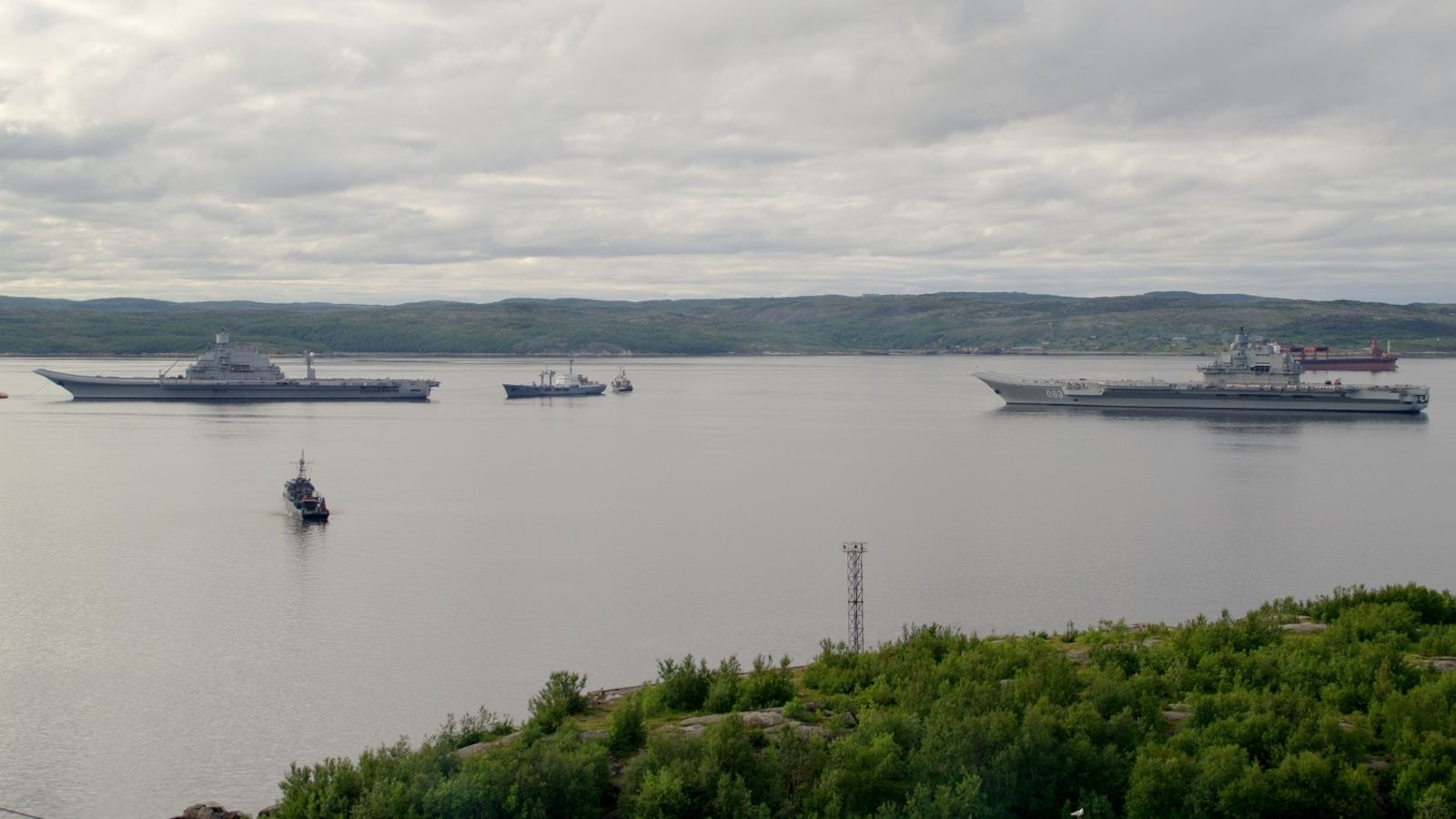
Things like, say, their two Kirov-class guided-missile battlecruisers Admiral Nakhimov and Pyotr Velikiy – both of which live in Severomorsk during normal service, and are attached to the Northern Fleet’s 43rd Missile Ship Division.
And why are they a big deal? Well, put it this way, the Varyag that we mentioned in the last chapter – itself a guided missile cruiser, and flagship of the Pacific Fleet – it comes in at about 11 to 12,000 tonnes, and packs sixteen P-1000 Vulkan anti-ship missiles in those big box launchers along the sides, plus 64 S-300F long-range SAMs and a stack of short-range missiles and guns to put the frighteners on enemy aircraft and light boats.
Sounds alright, doesn’t it? Until you then learn that the Kirov’s come in at 24 to 28 thousand tonnes, are nuclear powered, and in their most tarted up form, as per Nakhimov’s recent overhaul, have 80 vertical launch cells that can be loaded with Kalibr land-attack missiles, Oniks anti-ship missiles, or even the mighty Zircon; a hypersonic cruise missile believed to be able to hit Mach 9 when going in for the kill – i.e. nine times the speed of sound.
Consider also, the Admiral Kuznetsov – Russia’s only aircraft carrier. Sure, she’s been laid up since 2017 for never ending overhauls, thanks to a litany of comedy f*ck ups we don’t have time to go into today – but as the sole carrier, she remains very important all the same. And her home, when she works? That would be Severomorsk.
Beyond those headliners, the offerings get less exciting, but still remain notable.
For example, you have the Marshal Ustinov, the other Slava-class missile cruiser, and the Belgorod, an Oscar-II-class sub heavily modified for special operations work – stretched into the longest submarine on Earth so it can act as a mothership for deep-diving minisubs and, allegedly, use Poseidon nuclear-powered torpedoes.
As for the total number: that’d be in the order of 80 or so.
There’s another layer to all this as well, because prioritising the Northern Fleets isn’t just about the fact that Russia is on its own in that theatre, it’s because that stretch of ocean is starting to become very, very important – not just to Russia, but to the world.
You see, as Arctic sea ice retreats, the route along Russia’s northern coast becomes ice-free for ever longer periods within a given year, and thus can be used more reliably by commercial shipping – and this can shave 10 to 15 days off the length of a voyage between Europe and East Asia… and that’s compared to the Suez Canal route, not even the long way down around South Africa’s Cape of Good Hope.
Compared to that way, the northern route saves something in the order of 40 days… and in the world of shipping, time is money – less time at sea equals less fuel costs, less crew costs, more routes run per year. A huge deal, not just for national economies, but for you, and the cost of getting your next bag of Temu goodies plonked on your doorstep.
And Russia? Thanks to the ships they station in the Northern ZATO’s – they essentially control all of that route.
So yeah, they’re quite a big deal…
The Space Towns
And now, a category you all should have seen coming after our earlier mentioning of Baikonur, the ones that are all about space.
A key detail to stress as well – speaking of Baikonur – it is not counted as a ZATO by Decree 508, despite the special arrangement we earlier explained. The list is for Russian cities, and Russian cities only.
Certainly a shame, as it would have been fun to talk about this… and this… and indeed this, but alas, no.
What is on the list is Zvyozdny Gorodok, Mirny, Tsiolkovsky, Znamensk, and Krasnoznamensk. Less grand and pivotal to the whole effort than Baikonur, sure, but very important all the same.
Zvyozdny Gorodok – otherwise known as ‘Star City’ – for example, is home to the Yuri Gagarin Cosmonaut Training Centre.
And because we’re sure you don’t need us to explain what they do there to you, let’s instead talk about the fact that Zvyozdny Gorodok serves a great example of just how surprisingly ‘open’ a ZATO can sometimes be… because you can go there as a tourist…
And not just ‘a quick guided tour through the sheds’ tourism, either. If you have the money, and pass the background checks, they will let you do… everything, more or less.
They’ll stick you in the back of an IL-76 for a zero-g flight, they’ll let you have a spin in the centrifuge, they’ll lock you in a ‘space’ suit and push you in the weightlessness practice pool, feed you space food for the duration, and give you a go on whatever the hell a ‘Vestibular’ is.
It isn’t cheap, 71,000 Euros for the full package by our tot up – there used to be a Rubles option, but that disappeared after a certain geo-political oopsie poopsie back in 2022 made that currency worth slightly less than used toilet paper – but, the point remains: if you have the money, and pass the extensive vetting process, the doors of Zvyozdny Gorodok are wide open to you as a tourist.
Mirny, however, is most certainly not open for tourists, because it is built around the Plesetsk Cosmodrome, a spaceport used to launch the stuff that Russia wants to at least try to keep on the downlow: navigation satellites for the GLONASS system – Russia’s GPS alternative – Meridian and Raduga-type communications satellites, early-warning spacecraft that watch for missile launches, ocean-reconnaissance platforms like Pion-NKS… things like that.
Tsiolkovsky, out in Amur Oblast, is more of the same. The home of an old Soviet-built ICBM facility, now turned into ‘Vostochny’, a brand-new space port intended to wean Russia off of its Kazakh dependency for the bulk of its launches – you think Putin threw a tantrum when Ukraine started getting pally with the West, imagine the, dare we say, literal apocalyptic tantrum that could occur if the Kazakhs decided to basically pull the plug on the Russian space program.
It had a rocky start, admittedly – the Meteor-M launch in 2017 failed – but, they’ve got it sorted out since then, having more recently hosted multiple successful Soyuz missions.
Then there’s Znamensk, which is all about the development of military missiles rather than civil rockets – a distinction so slight that we may as well just cover it here.
It houses the Kapustin Yar test range – the first Soviet missile range ever built in fact – and continues to serve Independent Russia doing what it has always done; with the 9K720 short range ballistic missile and S-400 surface to air missile system both having had their first test launches there in 1998 and 1999 respectively.
And finally, Krasnoznamensk. It hosts the Titov Main Test and Space Systems Control Centre – essentially the main mission control for Russia’s military satellites. Easy.
The Strategic Rocket Force Garrisons
Speaking of things that are easy, our next category of ZATO is the Strategic Rocket Force Garrisons. Not the ones that develop and test them, like Znamensk, but the ones that actually just operate them. No more. No less.
No advanced envelope pushing technological development, no weird ‘you can go on holiday there if you have more brass than sense’ caveats, just fancy holes in the ground, with fancy missiles in them, and an otherwise very normal town bolted onto the side for the people who operate it all.
Consider that simplicity alongside the fact that there’s f*cking millions of them too, and what we have on our hands here, is a Chapter that risks being the worst thing of all… boring.
So, with that in mind then, let’s blast through these ones double quick, and move on.
Sibirsky. Solnechny. Komarovsky. Zvyozdny. Svetly. Svobodny. Uralsky. Ozyorny. Gorny. Voshod. Pervomaisky. Vlasikha – also serving as the Strategic Rocket Force’s Headquarters. Molodezhny – also hosting the main communication nodes for the Rocket Force.
And that’s your lot. They are ZATO’s. They have missiles. They might fire them at us one day. Ooooooooh. Scary.
Next. Chapter.
The Oddities
We really have saved the best till last for you all here, because now, as our final category of ZATO, we’re talking about the weird ones. The ones that serve ends so unique, that they defy fitting into any of our other categories, or, the ones that are so important, so naughty, and so opaque in what they do… that we barely even understand what they’re about.
Take Mezhgorye, to get us started. It is named by Decree 508, just as every other ZATO we have mentioned in this episode has been… and yet… Russia has yet to tell us why…
And just to make it weirder still, it’s also absolutely tiny – with an estimated population somewhere in the region of 15,000 as of the time of writing.
In fact, just look at it, it is the textbook definition of a sleepy little nowhere town. Dare we say, it even has a certain Liechtenstein-esque quality to it, what with the river to the side, and mountains penning it in – not exactly the kind of place you’d imagine Dr Evil building his secret lair, is it?
Except… it might actually exactly be the place where Dr Evil built his secret lair, because just to the East of Mezhgorye stands Mount Yamantau… and boy… is there some interesting things to be found around it.
Things like, for example, this, which we presume to be a horizontal access shaft, this, which we think is a vertical shaft of some sort, these other buildings with the exact same type of concrete slab road leading up to them, and even this not insignificant electrical substation plonked out just on the edge of all those buildings…
So yeah, clearly, there’s a bunker, or some kind of underground facility beneath the mountain, that much is rather obvious… but what exactly is under there?
Unfortunately, we have absolutely no idea. Moscow’s never told us, no former KGB man has ever let slip after one too many vodkas, and no document has ever fallen out of the Kremlin archives with the details – we genuinely, if we wish to hold ourselves to a decent standard of evidence, have to say that we just do not know.
The CIA, for what it’s worth, believe it to be some kind of enormous doomsday bunker, something vaguely akin to the Raven Rock and Cheyenne Mountain Complexes in the States – designed to house key supplies, key equipment, key personnel for the continuation-of-government after an all-out nuclear exchange.
And if you’re thinking that, surely, there must be at least one cheeky Russian who decided to pop over that way for a look about… indeed, you would be right… and we found him deep in the Cyrillic typing part of the internet.
Ready to get infuriated though? Because he got as far as here, and found some knackered old wooden buildings – seemingly totally unrelated to the complex under the mountains… at least not anymore.
And why’s that particularly infuriating, you ask? Well, it’s not just the disappointment of those huts being abandoned and or unrelated… it’s because he was only about 200 metres as the crow flies from the vertical shaft, where the answer to all this could be found.
There was also a guy who, somehow, got to the top of the mountain… only to find a very old, and very f*cked weather station… and that’s about it for photos. Anything else that comes up is just photos snapped in Mezhgorye proper.
So yeah… we have no idea.
Moving on then, to Solnechny – a tiny little island a smidge over 4.5 square kilometres in size, with an additional 200 metre “protected zone” in the lake around it, that isn’t even thought to house as many as 2,000 people.
Again, Moscow flatly does not tell us what happens here, but, there are clues scattered about here and there.
The ‘Zvezda’ plant, for example – a branch of the Pilyugin Scientific-Production Centre of Automation and Instrumentation – is very close by, which became a pioneer in high-precision float gyroscopic instruments, a vital part of missile guidance systems, during the Soviet period, and to this day continues to manufacture gyroscopes, accelerometers, and other high-sensitivity precision parts that find their way both into missiles, and civil rockets.
More clues come from Roscosmos – the proper name for the Russian Space Agency – as an order of theirs, No. 336, issued on the 17th of November 2021, signed by Dmitry Rogozin, the then General Director, just straight up – among other things – listed off all the buildings on Solnechny, with the list including an:
- Administrative-technological building.
- Tooling & apparatus manufacturing building.
- Mechanical assembly building.
- Ceramic-thermal building.
- Optical-ceramic building.
- Blanking/prep section.
- Materials storeroom.
- Assembly-and-testing building.
- Arched warehouse.
- Central materials warehouse.
- And a sewing workshop.
Combine all of that together, and suddenly we have a working theory, don’t we? It’s probably an assembly and test complex for advanced missile and rocket components, likely guidance systems specifically.
Further still, to really seal this theory in as the one to put your money on, we know from that brief window where Western historians were allowed into the Kremlin archives in the early ‘90’s, that the island has a long association with rocketry. Chiefly because it was there that the Soviet Union dumped all of their captured Nazi rocket-scientists, to put them to work as part of the intentionally vaguely named ‘NII-88 Branch No. 1’…
Therefore then, as much as Russia has never come out and said “this is what we do here, behold”… we think we’ve pretty much got it figured out here.
And finally, both for this Chapter, and indeed the whole episode, we have Raduzhny.
This one isn’t weird because we don’t know exactly what’s going on there, it’s weird because we do know, and it just defies all of our other categories… because Raduzhny’s schtick… is lasers.
It all began back in February 1971, when the Soviet Council of Ministers signed off on an “inter-departmental centre” for laser work in the forests outside the City of Vladimir – and then simply built an entire closed town around it to house the people and the kit.
Now, 50ish years later, it’s a “science-intensive, defence-oriented” enterprise – i.e. a full-blown laser developing Mecca, with Raduzhny’s job being to design, build, and range-test experimental laser and opto-electronic systems of all flavours.
And because a lot of that stuff is a bit dull, to be quite frank, let’s wind the clock back and give you an example of something they made back in the Soviet period that is decidedly not dull instead: The 1K17, a later multi-channel laser firing tank, built on the chassis of a 2S19 Msta-S self-propelled howitzer, and designed to blind optical and opto-electronic systems over long ranges.
Conclusion
And that, for today, is it: every disclosed Closed City currently in Russia – what they’re about, what they do, and of course, the history.
So, what should we take away from it all?
Well, firstly – and perhaps obviously – that they are very much a real thing; and a serious thing at that. No small scale one or two naughty black sites type deal, but 38 settlements of various sizes, all kept under strict lock and key, all for the furtherance of the vital defence and aerospace activities.
Like we say though, that stuff’s obvious – a rehash of what we just talked about.
What is less obvious, and all the more worth our time therefore, is the matter of what the ZATO’s tell us about Modern Russia.
And if you ask us, above all else, they are exemplary of the fact that the nation has a very different relationship with its Soviet past as compared to its former comrades.
Because Ukraine, Estonia, all of the other Republics in fact – save for the one-off kind of exception of Kazakhstan – have done away with the Closed Cities. As indeed, many of them have made a proactive effort to do away with their Soviet inheritances more broadly; viewing them either as remnants of colonialism, or simply remnants of a dark and unpleasant history they don’t wish to be overly reminded of.
Consider Ukraine, as an example: their 2015 law ‘On the Condemnation of the Communist and National Socialist (Nazi) Regimes, and Prohibition of Propaganda of their Symbols’, saw Communist legacy place names changed, and monuments and symbols removed.
And Ukraine weren’t the only ones either, with Moldova’s ‘Law No. 192’, Georgia’s ‘Freedom Charter’, Latvia’s ‘Law on Safety of Public Entertainment’, and Lithuania’s ‘Law on Meetings’ all being cut from the same cloth.
Russia however… has not done that. They are… well… Russian… yes, but being ‘post-Soviet’ is an explicit and venerated part of that identity – at least as far as the state is concerned.
Putin, for example, restored the Soviet anthem in 2000 – jingle wise at least. Victory Day, the annual commemoration of the end of WWII in Europe, remains riddled with Soviet iconography. And many streets retain their Communist-period names too.
Even key institutions – and not just the bread and butter daily running of the state ones – are just their Soviet iteration, with the hammer and sickle swapped out for a double headed eagle. The bulk of the KGB, for example, became the FSB. The KGB’s First Chief Directorate became the SVR, and its Ninth Directorate became the FSO. And indeed, the ‘Closed Cities’, as informal as they always were as entities, became the ZATO’s.
And that, in abstract, is what the ZATO’s are. Evidence of the fact that while 14 of the 15 former Republics are post-Soviet, Russia is the only one that is post-Soviet…

Simon Whistler
Simon Whistler is one of YouTube's most prolific educational creators, with tens of millions of subscribers across his channels. Places is his expedition into the world's most remarkable locations — from cities carved from salt to islands nobody dares inhabit. He brings a researcher's rigour and a traveller's awe to every field note.
Frequently Asked Questions
What is a Closed City?
A Closed City is a settlement with a specific primary purpose: to facilitate and support the execution of top-secret matters of state. They are built from the ground up for this purpose, with everything else in the city existing to support it.
How many Closed Cities are there in Russia?
There are 38 Closed Cities in Russia, officially known as ZATOs (Closed Administrative-Territorial Units).
What are the benefits of living in a ZATO?
Residents of ZATOs receive an increased level of budgetary provision, measures of social protection, benefits in wages, state insurance, and job guarantees. They also enjoy a sense of community and safety.
What is life like inside a Closed City?
Life inside a Closed City is described as safe and prosperous by Russian standards. However, it can also be boring due to the isolation. Residents enjoy benefits and a strong sense of community.
What are the Atomgrads?
The Atomgrads are a specific type of ZATO dedicated to nuclear research and development. There are 10 Atomgrads in Russia, including Sarov, Snezhinsk, and Ozersk.
What is the significance of the Northern Fleet ZATOs?
The Northern Fleet ZATOs are crucial because they house Russia’s most advanced naval assets, including nuclear-powered submarines and guided-missile cruisers. They also control strategic Arctic routes.
What is the purpose of the Strategic Rocket Force Garrisons?
The Strategic Rocket Force Garrisons are ZATOs that operate strategic missiles. They are essentially towns built around missile silos and the infrastructure needed to support them.
What is the role of Zvyozdny Gorodok?
Zvyozdny Gorodok, also known as Star City, is home to the Yuri Gagarin Cosmonaut Training Centre. It is surprisingly open to tourists who pass background checks and can afford the experience.
What is the mystery surrounding Mezhgorye?
Mezhgorye is a small ZATO near Mount Yamantau, which is believed to house an enormous underground facility. The exact purpose of this facility is unknown, but theories suggest it could be a doomsday bunker.
What is the significance of Raduzhny?
Raduzhny is a ZATO dedicated to the development of laser and opto-electronic systems. It has a long history of laser research and development, including the creation of laser-firing tanks.
Sources
- Original Places video: Russia Has Dozens of Cities It Doesn’t Want You to See
- Hero image source by Gorbatuy111 / openverse, by-sa.