
It was August 18th, 1976.
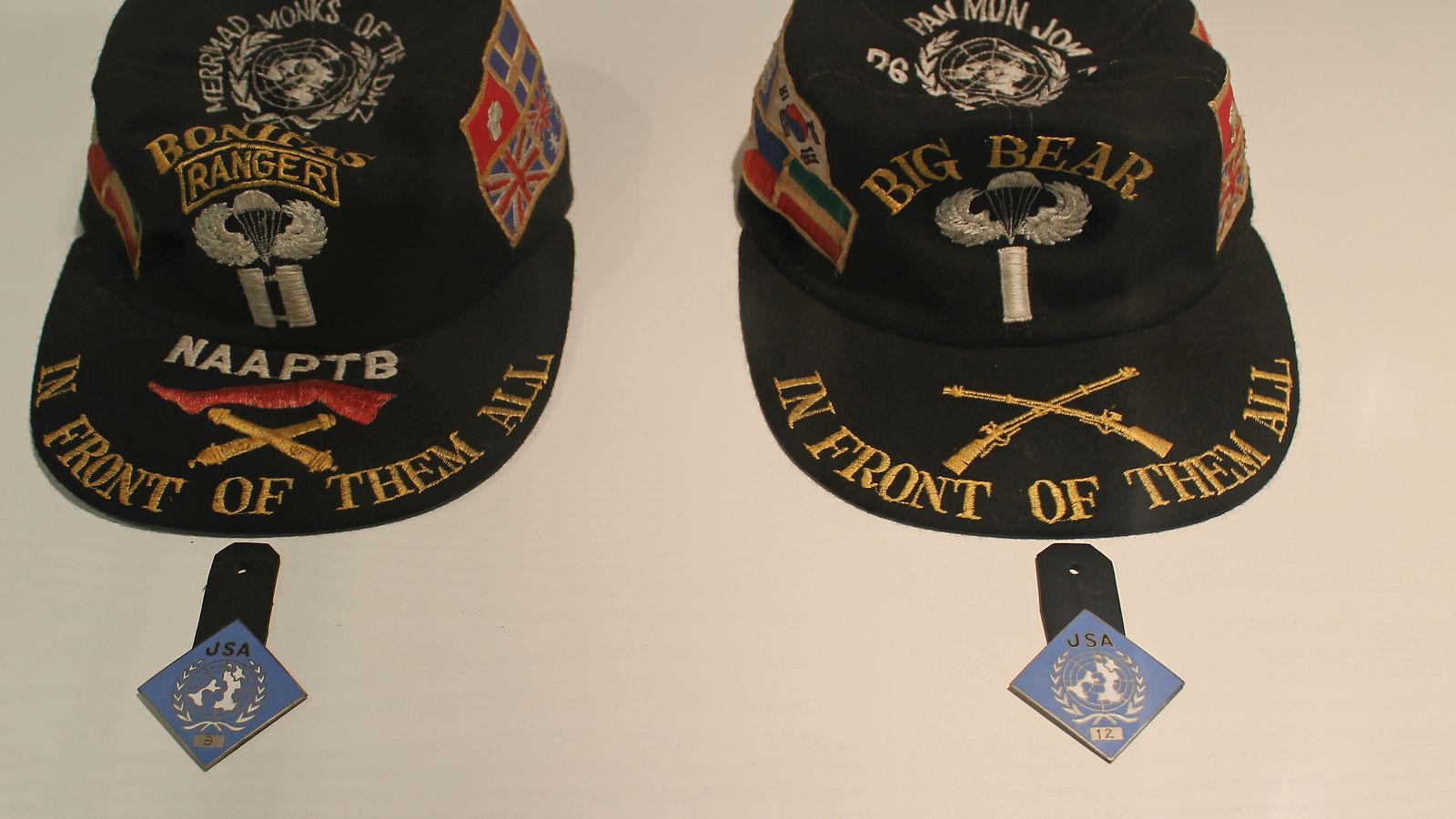
At the heart of the Korean Peninsula, a group of soldiers from the US Army’s Korean Service Corps were at work, trimming a poplar tree which obscured the view of a nearby United Nations observation point. The group, composed of South Koreans and Americans, was accompanied by a security detail, amongst whom were 33-year-old Captain Arthur Bonifas and 25-year-old First Lieutenant Mark Bennett.
As they worked, a North Korean detachment approached. Speaking to Bonifas, they commanded that the group immediately stop cutting the tree, which they claimed had been planted by their leader Kim Il-Sung himself. Although neither side was armed, the atmosphere suddenly turned as tense as the environment in which all of them were standing.
Key Takeaways
- The Korean Demilitarized Zone (DMZ) is a heavily fortified buffer between North and South Korea.
- The DMZ’s Joint Security Area allows North and South Korean soldiers to face each other.
- The 1976 axe murder incident highlighted the ongoing tensions and potential for violence in the DMZ.
- The DMZ has become an unintentional nature preserve due to minimal human interference.
- Recent actions by North Korea indicate deteriorating relations and potential for renewed conflict.
This was the Korean Peninsula Demilitarised Zone, or DMZ — specifically the Joint Security Area, one of only two recognised crossing points along the divide between the Koreas. As with any demilitarised zone, no weapons other than small side arms are permitted within. Even so, it remains one of precious few places where North and South Korean soldiers — who are still technically at war — could encounter one another face-to-face.
Bonifas ignored the command from the North Koreans. And what followed was a thirty-second episode of frenzied violence, which had almost certainly been premeditated. The Americans and South Koreans retreated back towards safety, several of them now heavily injured. Behind them, they left the half-cut tree and the disfigured bodies of Bonifas and Bennett — who’d been bludgeoned and hacked to death by the North Koreans, using the axes and tools used to trim the poplar.
The incident sparked an international furore, becoming known as the Korean Axe Murder Incident or the Panmunjom Axe Atrocity.
And it was a clear-cut reminder of the perpetual state of war that the demilitarised region has remained in since 1953.
Welcome to the DMZ
So what exactly is the DMZ — what is its purpose, and what is the role of the Joint Security Area at its heart?
Well, the DMZ is a land buffer between North and South Korea, a sort of sheath around the dividing line between the two countries which lies at its centre. That line itself isn’t really a border, since neither country recognises the independence of the other and both claim one another as their rightful territory. As such, the divide is known as the Military Demarcation Line or MDL, which in practice acts as the true border between North Korea and South Korea. And the zone around it is probably just about the most fortified patch of territory in the world.
The DMZ is 250 kilometers long, running the full breadth of the peninsula from the Yellow Sea to the Sea of Japan. It is 4 kilometres thick, its parameters established by the terms of the armistice agreement of 1953, which saw the warring parties each withdraw 2km to their respective sides of the line. The fringes of the DMZ are therefore marked by the presence of hundreds of thousands of troops and intimidating tracts of barbed wire, further complete with positioned artillery, heavy and light arms, watchdogs, observation posts and alarms.
Foreboding watchtowers dot the horizon, and advanced surveillance technology tracks movements within the restricted area. Guards pace back and forth, and the villages which once dotted the landscape have been cleared, to prevent any civilians being caught by the invariable dangers in and around the zone. The Armistice Line sits somewhere in the middle of the exclusion area, although it isn’t physically defined, meaning that, in theory, one could easily wander across it without obstruction.
In practice, though, this would never happen. Because in addition to the obsessive levels of surveillance, the area is riddled with land mines — it is estimated that up to 2 million of these have been planted the length and breadth of the DMZ.
So given such a level of obsessive security, how was it possible that the two groups came into contact with each other so openly on that August day in 1976?
Well perhaps the most well-known portion of the buffer is the aforementioned Joint Security Area, an 800-metre-wide, 400-metre-long security interface located close to the former village of Panmunjom. The interface lies deep within the DMZ, more or less in a direct line between Seoul in the south and Pyongyang in the north. Aside from the infamous poplar tree that nearly furiously revived the Korean War, the JSA features several more of the most symbolic and recognisable sites from the conflict.
Its centerpiece on the South Korean side is the four-story Freedom House, built in 1965, which is sometimes used for talks between leaders. The equivalent on the northern side is the hulking Phanmun pavilion, built in 1969 for the same purpose. Located in between both are the famous little blue cabins which straddle the demarcation line, where North and South Korean forces stand directly face to face with one another, and where the 1953 armistice was signed.
Also nearby, and still within the JSA, is the notorious Bridge of No Return — the site of tense prisoner exchanges between 1953 and 1976. The bridge was named for the ultimatum given to all prisoners before they crossed: that they could stay in the country where they were captive or return to their homeland, but once they stepped over the demarcation line, there would be no turning back. Many of these exchanges took place in the immediate aftermath of the war, or in the 1960s, during a three-year period of renewed hostilities known as the DMZ Conflict.
The conflict saw around 1,000 soldiers from both sides killed and thousands arrested, including huge volumes of infiltrators sent from the North to foment demoralisation and dissent in the ranks of the South Korean and American forces.
And given the close proximity of the opposing forces in what remains — theoretically — an active war, it is within the JSA that both sides engage in dramatic military displays to show off their respective military potential.
Perhaps most notably, following the 1976 axe murders, the US launched Operation Paul Bunyan: a massive show of force involving aircraft carriers, B-52 bombers, and thousands of troops…all to cut down one tree. But if the true objective was to cow the North into backing down, it had the desired effect: Pyongyang did back down, the tree was cut without a fuss, and Kim Il-Sung issued a formal statement of regret for the deaths of Bonifas and Bennett.
Although the JSA has — in recent years — been the subject of tours and increased global intrigue, there is little escaping its permanently tense atmosphere, likely to erupt at any given moment. As a testament to this, the JSA has seen several dramatic episodes of defection in recent years — such as in November 2017, when North Korean soldier Oh Chong-Song drove directly up to the armistice line, crashed under fire, was shot five times by his countrymen, but ultimately succeeding in dragging himself across the divide where he was rescued by personnel from the South. The same occurred in reverse in 2023, when Private Travis King, facing disciplinary charges by the US Army, crossed into North Korea while on a civilian tour of the DMZ. After weeks of negotiations, he was expelled from the North and returned to the US to face desertion and insubordination charges.
So…why is it all this intense?
Well, because the nature of the war which preceded the establishment of the DMZ was — in several ways — quite different from any conflict occurring before or since.
The Land of Constant Sorrow
Now, you probably already know about the Korean War, which took place from 1950 to 1953. What you might not know — and what is particularly relevant in this context — is the back-and-forth pattern the war followed, which perhaps helps explain the extreme paranoia felt by both sides to this day.
Before the war, the Korean peninsula had been divided into North and South under the initiative of the US, creating the communist Democratic People’s Republic of Korea (or the DPRK) and the Republic of Korea, or ROK. This brought to an end more than three decades of Japanese occupation, following the annexation of Korea by Imperial Japan in 1910. The two Koreas operated under US- and Soviet spheres of control, just as would subsequently become the case in Europe, most notably in Germany.
The dividing line was chosen as the 38th parallel of latitude — roughly halfway up the peninsula, which placed Seoul (the longtime capital of Korea) in the US sphere, but still left roughly half of Korean territory to the Soviets. However, both sides continued to lay claim to the other — and the North, being military much better-equipped, decided to enforce its claim decisively on the 25th of June 1950.
At dawn that day, the North Korean People’s Army surged across the parallel toward Seoul, with their freshly-supplied Soviet T-34 tanks in tow. Their objective was to quickly overcome the fledgling Republic of Korea and unify the peninsula under communist rule. And they nearly succeeded in doing exactly that.
The South Korean forces were ill-equipped and outnumbered, and the offensive caused Seoul to fall within days. The world watched on in horror, as the first act of what would become the Cold War took form. In only two months, the North pushed the South all the way to a tiny portion of territory in the peninsula’s southeast, known as the Busan pocket. By mid-September, the North Koreans were slowly inching forward on this remaining portion of territory too.
And so the United States decided to intervene. A coalition of national military forces was assembled under the banner of the United Nations, led by General Douglas MacArthur — fabled for his exploits in the Pacific Theatre during World War II. On September 20th, MacArthur’s forces landed at Incheon, on the western coast of Korea, and swiftly turned the tide of the war: recapturing Seoul and driving the North Koreans back across the parallel in a hasty retreat.
But their overzealous advance brought them uncomfortably close to the Chinese border from where the PRC — freshly communist itself following victory in the Chinese Civil War the previous year — watched with nervousness. And so they, too, got involved.
As hundreds of thousands of Chinese troops entered the fray, the coalition was driven back south, with many soldiers suffering the effects of frostbite and exhaustion as the winter months set in. The 38th parallel was again breached, in a military back-and-forth that soon earned the nickname “the See-Saw War”.
What all this meant was that — by the time the armistice was eventually signed in 1953 — both sides had come close to annihilation in the course of the same conflict.
Moreover, trust between the two had simply evaporated: the South could recall the unprovoked charge which laid waste to their country, driving them to Busan and the brink of obliteration. The North could recall the devastating intervention by the US which had, equally, nearly driven them across the Yalu river into China. And it wasn’t as if any political change-of-guard had occurred, that would assuage the threat felt by one or the other.
Although the frontier was now roughly back at the point of departure, North Korea was still led by Kim Il-Sung, the former guerrilla leader who’d directed the attack on the south in 1950. And across the border, the Americans were still lurking — seen, as they were, by the North Koreans (with the aid of massive propaganda) as imperialist agitators who would see their country reduced to ruin.
Villages had been bombed, mountains turned to rubble, and infrastructure laid to waste. An estimated 3 to 4 million people died, of whom the vast majority were civilians. Abductions, torture, and other unjustices had also taken place — with the North having kidnapped an estimated 85,000 people during the war and disappearing them into the void beyond the parallel. Sadly, these abductions would even continue beyond the armistice and would include some high-profile people from South Korean society — as we shall see a little later.
In short, whatever peace would reign was bound to be a highly tenuous one, absent of any mutual trust whatsoever.
So when after endless negotiations, an armistice was signed at Panmunjom, it did bring the most intense sequence of fighting to an end. But it wasn’t peace — it was a ceasefire. Korea remained divided, and the threat posed by the other remained real and present. With it, the DMZ took form.
Fences and watchtowers were installed, and hundreds of rounds of weapons were trained permanently in the opposite direction from both sides. Moreover, within the clearing in between, hundreds of villages had to be cleared, forcing thousands from their homes. Today, save for military patrols, the DMZ is entirely devoid of human life.
Watch The Project Briefing
Open Video
Video Briefing
The Region at War for 70 Years.
But…that’s not entirely true.
Living With Our Backs to One Another
Daeseong-Dong must rank as one of the loneliest permanently inhabited villages in the world.
A village of a little over a hundred people, at first glance it doesn’t look like anything out of the ordinary. A number of quiet, sleepy homes, surrounded by lush, uninterrupted nature and several small fields. But a look a little closer would reveal several unusual features: Daeseong-Dong doesn’t have any restaurants, shops or medical facilities.
It has an enormous flagpole topped by a South Korean flag, dwarfing the entire village at a hundred metres tall. And while there are only 130 mostly-elderly residents, the village also features some 800 military personnel, permanently stationed there to shepherd the villagers to their everyday tasks.
You see, Daeseong-Dong — or Freedom Village — is located deep within the DMZ, only about 300 metres from the border with North Korea, and with an unobstructed patch of land being the only thing separating it from the enemy lurking in the north.
The village is the product of one of the more unusual provisions of the armistice, which allowed that particular settlement to continue to be inhabited as a blueprint toward potential reunification someday. Residents of Daeseong-Dong are offered particular incentives to continue residing there: they are excluded from South Korea’s mandatory military service term of two years, and offered tax breaks and favourable land leases. But everyday life in the village is hardly idyllic.
The villagers have a nighttime curfew from 7pm, after which they are no longer allowed to leave their homes under any circumstances. They undergo strict security measures to even enter their own village from outside the DMZ, and external visitors must receive a security clearance two weeks before arriving. The villagers have had to put up with the ever-present threat of disruption posed by the North, as well as loudspeakers which once blared slogans, music, and threats across the border.
The South responded in kind, blasting its own broadcasts of K-pop and democratic messaging towards the North. And although these broadcasts were intermittently halted in recent years, the psychological duel continues in other ways.
Kim Dong-Rae has resided in Daeseong-Dong all her life. In an interview with the BBC, the octogenarian stated that she rarely left the village, only for hair appointments outside the DMZ once every two months. Like others, she paid a heavy price for her continued residency there. Her husband was shot in the abdomen by North Korean soldiers and died — leaving her to raise their six children on her own.
Most young people have decided that to reside there — despite the incentives — is not worth the hassle, and the village is slowly losing its inhabitants as the years go by.
Daeseong-Dong is — theoretically — not alone. Only a few hundred metres away, on the other side of the demarcation line and still deep within the buffer zone, sits its sister village Kijŏng-dong — also known as ‘Peace Village’ but generally nicknamed ‘Propaganda Village’. Kijong-Dong features gleaming buildings and its own towering flagpole, erected in the 1980s to surpass the South Korean installation.
It was once the tallest flagpole in the world, at more than 160 metres in height, and is easily visible from across the divide in the South. The number of residents in the North Korean village is not known. Except that it is known: zero.
You see, Kijong-Dong is known to be a Potemkin village, essentially a bunch of empty houses intended to make life in the DPRK look — from a distance — comfortable and plentiful. But observers — who, keep in mind, have little to do other than scrutinise distant patterns of movement all day — have noticed a number of rather suspicious features. Lights in the Kijong-Dong’s ornate buildings appear to go on and off cyclically and at set hours, as if they were on a timer.
Very few people are actually ever seen there, and those that have been spotted appear to be simply caretakers tending the roads of the settlement. In short, the village is nothing but smoke and mirrors, other than the enormous fluttering flagpole sitting at its centre.
And while North Korea may feign that Kijong-Dong is inhabited, there is practically no chance that this would ever be permitted, given the ease of defection across the unobstructed divide or the risk of being swayed by the honeyed propaganda from Daeseong-Dong. In theory, there’s similarly nothing to prevent the people of Daeseong-Dong from crossing the invisible divide and heading north, if they wished to do so. Except they’d probably be shot.
Or arrested as infiltrators or agitators and then shot, or sent to detention camps. As an extra precaution therefore, the villagers can only enter even their own fields under a strict military escort.
In general, South Korean civilians and military alike are treated with great hostility by the North and those who strayed too close to the dividing line have become statistics of the DPRK’s obsessive insularity. The same — however — has not always been true of American defectors, some of whom crossed into the North during the war or in the period thereafter, as well as a handful who refused to be repatriated during the DMZ conflict in the 1960s. The most recent US defector was the aforementioned Private Travis King, who crossed into North Korea from the JSA, located only a few hundred metres away from Daeseong-Dong.
Some Americans who did the same during the Civil War remained in North Korea and even became actors in state-produced propaganda films — although the same was not true of Private King, who after being court-martialled for abandoning his post was given a dishonourable discharge from the army. Still, given the open nature of the zone, the people of Daeseong-Dong could cross the divide freely if they so desired. Similarly, there would be little to prevent the people of Kijong-Dong from crossing over into the South…if they existed.
But even if South Korean would-be defectors survived such a venture, life on the other side of the divide would hardly be roses. After all, it is not that South Koreans have never before ended up in the North.
Two years after the Panmunjom Axe Murder incident, in 1978, South Korean actress Choi Eun-Hee was lured to Hong Kong, kidnapped and smuggled to North Korea. Choi was a star of South Korean cinema in the 1960s and 1970s, often appearing alongside her husband Shin Sang-Kok, and apparently counted Kim Il-Sung as one of her fans. She was brought against her will to Pyongyang and spent years as a hostage under the DPRK Leader.
Six months after her abduction, Shin was also abducted in Hong Kong and similarly brought to Pyongyang. The pair were then made to make North Korean films together, some of which were rapturously applauded by film critics… from the Soviet Union. Choi and Shin had actually divorced years before their abductions, a split which had hurt Choi’s career, for which reason she’d travelled to Hong Kong in an attempt to revive it.
Shin, meanwhile, had started a family with another woman. But they remarried on the “recommendation” of Kim Il-Sung, and remained married after they managed to escape during a visit to Vienna in 1986, and up until Shin’s death in 2006.
They were comparatively lucky.
Kim Dong-Shik was a Korean-American pastor living in China, who’d been carrying out work on behalf of North Korean defectors, helping them escape to safety. He is assumed to have died in a North Korean penal colony several years after being kidnapped in Yanji, near the North Korean border, in 2000. Jin Gyeong-Suk was another noteworthy case.
A North Korean, she succeeded in defecting to the South in 2002, but was also abducted in China while on her honeymoon in 2004. She was interrogated, tortured, and finally murdered in the Chongjin concentration camp soon after. In the period post-1953, almost 4,000 people from South Korea have been kidnapped and transported to the North — the vast majority of them being unfortunate fishermen — and it is believed that several hundred of these may still be living there, but with their fates otherwise unknown.
And although the number of such abductions has fallen in recent years, the kidnapped have included everyone from high school students to military staff — to the extent that a law on the entitlements of rescued abductees was passed in the South in 2007.
Certainly enough reason, then, for the tiny community of Daeseong-Dong and other South Koreans to steer far clear of the North and the potential traps set out by its government in or around the DMZ. So great is the threat from the North that — in addition to the exclusion zone itself, South Korea added a zone of restricted access — known as the Civilian Control Zone, or CCZ — for an additional eight kilometres beyond the southern limit of the DMZ.
But curiously, what has risen from the resulting void is one of the most untouched nature preserves found anywhere in the world.
A Flourishing Nature Preserve
Being at the epicentre of one of the most volatile sequences of fighting, the area around the DMZ suffered intense damage during the three years of war. But the period since then has proved an entirely different story.
With minimal human interference for more than seventy years, local ecosystems have recovered, creating an enormous haven of biodiversity in the area’s marshes, forests, mountains, riverbanks and wetlands. A remarkable plant and animal life has emerged in what is essentially now the world’s largest terrarium, almost entirely closed off to human access. And although it comprises only 1.6% of South Korea’s land area, the DMZ is estimated to be home to around 20% of living animal species found in the country.
Surveys have identified some 6,000 different plants and animals in the area, including roughly 70 mammal species, 320 bird species, and nearly 3,000 different plant species. The area features wild boars, musk deer, red- and white‑naped cranes, Asian black bears, Eurasian black vultures, Siberian flying squirrels, and rocky mountain goats. There have even been sightings of the very rare Amur leopard and Siberian tigers, and western gray whales roam the waters nearby the restricted area.
Paradoxically, the combination of desolation caused by the human evacuation and the surrounding high-security environment has provided perfect conditions for such an ecosystem to both thrive and be observed. The camera traps and drones have been able to document the goats, otters, and other critters — as well as rarities such as asian black bears, amurs, and the leopard cat — which generally hunts at night and is therefore infrequently seen to human eyes. The military-enforced exclusion has prevented any humans from trespassing, who might otherwise disturb the life developing there, and the result is one of the most flourishing environments seen anywhere in the world. Moreover, unlike places bereft of human habitation due to poor climate, the DMZ is perfectly temperate, and the once-fertile agricultural land has converted into forests and valleys labelled by UNESCO as a rare, high-quality temperate ecosystem.
As such, any peace endeavours could represent something of a conservation dilemma, since the effort to demine the DMZ and remove the defensive perimeters would invite human access which could upset the fragile habitats thriving there.
In practice, however, the ecosystem seems safe for now. Because the chance of a thaw in relations in the near future appears woefully unlikely.
Storm Clouds Gather
Now, you could say that the prospects of peace on the Korean peninsula have recently looked brighter than ever.
The Soviet Union — North Korea’s greatest backer — collapsed and folded in 1991, after which the North became more politically isolated and, lacking USSR funding, more impoverished and famine-prone. In theory, this would hardly improve their warfaring ability, lending leverage to the prospect of a sustainable peace agreement. The North also seems to have largely stopped kidnapping South Koreans, and current DPRK leader Kim Jong-Un has met three times with current US President Donald Trump during the latter’s first term — once in Singapore, once at the DMZ, and once during an unprecedented two-day trip to Hanoi, Vietnam. Promising signs, right?
No.
In fact, relations could not be worse, and appear to be deteriorating fast.
In recent years, North Korea has continued its testing of nuclear weapons, a particular bone of contention with the South and its primary ally, the US. In January 2024, Kim Jong Un announced that peaceful reunification with Seoul was no longer possible, declaring South Korea the DPRK’s ‘principal enemy’ and proposing to identify it as a ‘hostile state’ in the North Korean constitution. He further announced the discontinuation of several reunification committees, and the Arch of Reunification — a monument built in Pyongyang in 2001 was demolished only a few days later.
The North Korean leader continued his streak in June by announcing the suspension of the 2018 Panmunjom Declaration, a bilateral agreement between North and South focused on officially ending the Korean War, pursuing peace and reconciliation initiatives, and denuclearising the peninsula. Later that summer, North Korea resumed blaring propaganda across the border and sending propaganda leaflets and balloons filled with rubbish and excrement across the border to the south. In October, North Korea blew up roads linking it to the South, for which South Korea rather wistfully demanded repayment of 125 million dollars it had provided the North Korea for their construction.
In the time since, the DPRK has not only further expanded its weapons testing and provocative incursions near South Korean islands, but also displayed ever-closer ties with China and Russia. This included sending troops to fight alongside Russia in Kursk in what some observers described as a stresstest to gauge the fighting capacities of North Korean forces ahead of a potential return to fighting with the South. A 2024 piece by noted North Korea experts declared their belief that Kim Jong-Un had — by January that year — already decided to return to war, and that — if that were to pass — given the North’s nuclear capacities (quote):
“…victory in the ensuing war will be empty. The wreckage, boundless and bare, will stretch as far as the eye can see.”
Youtuber Wendover Productions added that the current timing would be ideal for such an intervention, with the eyes of the world focused on wars between Ukraine and Russia, Hamas and Israel, and on increased tension between China and Taiwan. North Korea — if an opportunity arose — wouldn’t need a pretext to attack, either. With the war still technically ongoing, no act of war would be necessary to begin a renewed assault on the South — on this occasion, with battle-hardened soldiers and an expanded military arsenal in two.
How such a war would go is anybody’s guess. But once thing is clear: it would mean the loss of potentially millions of Korean lives. It would put paid to the bioverse wonderland currently lying between the two Koreas. It would mean a return to the violence and deprivation not experienced by several generations of Koreans in the south.
It would end the economic miracle which South Korea has been described as in recent years. It would devastate Daeseong-Dong and many more villages like it. And it could be the first all-out nuclear war in history.
The region at war for 70 years could see something unlike anything it has ever experienced in its history.

Simon Whistler
Simon Whistler is one of YouTube's most prolific educational creators, with tens of millions of subscribers across his channels. Places is his expedition into the world's most remarkable locations — from cities carved from salt to islands nobody dares inhabit. He brings a researcher's rigour and a traveller's awe to every field note.
Frequently Asked Questions
What is the DMZ and its purpose?
The DMZ is a 250-kilometer-long, 4-kilometer-thick land buffer between North and South Korea, established by the 1953 armistice agreement. It serves as a sheath around the Military Demarcation Line (MDL), which acts as the true border between the two countries. The DMZ is heavily fortified with troops, barbed wire, artillery, and surveillance technology to prevent any unauthorized crossing.
What is the Joint Security Area (JSA)?
The JSA is an 800-meter-wide, 400-meter-long security interface located within the DMZ. It is one of only two recognized crossing points along the divide between the Koreas and is the site of several symbolic and recognizable locations, including the Freedom House, the Phanmun pavilion, and the Bridge of No Return.
What happened during the Korean Axe Murder Incident?
On August 18th, 1976, North Korean soldiers attacked a group of US and South Korean soldiers who were trimming a poplar tree in the JSA. The North Koreans killed Captain Arthur Bonifas and First Lieutenant Mark Bennett using axes and tools. This incident sparked international outrage and highlighted the ongoing state of war between the two Koreas.
What is the significance of the Military Demarcation Line (MDL)?
The MDL is the line that divides North and South Korea and acts as the true border between the two countries. Neither side recognizes the independence of the other, and both claim the entire peninsula as their territory. The DMZ surrounds the MDL and is heavily fortified to prevent any unauthorized crossing.
What is the history of the Korean War and its impact on the DMZ?
The Korean War took place from 1950 to 1953 and involved a back-and-forth pattern of fighting between North and South Korea, with the intervention of the United Nations and China. The war resulted in the destruction of villages, infrastructure, and the loss of millions of lives. The armistice signed in 1953 established the DMZ as a buffer zone between the two countries, which remains heavily fortified to this day.
What is Daeseong-Dong and its significance?
Daeseong-Dong, also known as Freedom Village, is a village of about 130 people located deep within the DMZ, only 300 meters from the border with North Korea. It is one of the few permanently inhabited villages in the DMZ and serves as a symbol of potential reunification between North and South Korea. Residents of Daeseong-Dong are offered incentives to live there, but they face strict security measures and the constant threat of disruption from the North.
What is Kijŏng-dong and its purpose?
Kijŏng-dong, also known as ‘Peace Village’ or ‘Propaganda Village,’ is a North Korean village located near the border with South Korea. It features gleaming buildings and a towering flagpole but is actually a Potemkin village, intended to make life in the DPRK look comfortable and plentiful from a distance. The village is uninhabited and serves as a propaganda tool for the North Korean government.
What is the ecological significance of the DMZ?
The DMZ has become one of the most untouched nature preserves in the world due to minimal human interference for over 70 years. It is home to a remarkable diversity of plant and animal life, including some rare and endangered species. The ecosystem in the DMZ is considered a high-quality temperate ecosystem and is protected by the surrounding high-security environment.
What are the current tensions between North and South Korea?
Tensions between North and South Korea remain high, with North Korea continuing its testing of nuclear weapons and provocative incursions near South Korean islands. In 2024, North Korean leader Kim Jong-Un declared South Korea the DPRK’s ‘principal enemy’ and proposed identifying it as a ‘hostile state’ in the North Korean constitution. The North has also resumed blaring propaganda across the border and sending propaganda leaflets and balloons filled with rubbish and excrement to the South.
What is the potential impact of a renewed conflict between North and South Korea?
A renewed conflict between North and South Korea would likely result in the loss of potentially millions of Korean lives, the destruction of the biodiverse ecosystem in the DMZ, and the end of the economic miracle that South Korea has experienced in recent years. It could also be the first all-out nuclear war in history, with devastating consequences for the region and the world.
Sources
- Original Places video: The Region at War for 70 Years.
- https://www.archives.gov/milestone-documents/armistice-agreement-restoration-south-korean-state
- https://www.reuters.com/world/site-us-nationals-crossing-into-north-korea-has-history-diplomatic-military-2023-07-18/
- https://youtu.be/ZxK_7XcQETw?si=3vfJ7nibquDOtURt
- https://www.dailynk.com/english/victims-of-abduction-jin-kyung-soo/
- https://en.yna.co.kr/view/AEN20240524001351315
- https://en.wikipedia.org/wiki/House_of_Freedom
- https://en.wikipedia.org/wiki/Phanmun_Pavilion
- https://milewis.wordpress.com/2010/05/01/the-bridge-of-no-return/
- https://www.politico.com/magazine/story/2017/09/14/north-korea-1976-axe-murder-incident-215605/
- https://m2now.com/what-its-like-visiting-the-korean-dmz-for-the-first-time/
- https://youtu.be/eyqoU-4WYrE?si=8gLhqs0W_sEnVeWm&t=514
- https://www.theguardian.com/us-news/2024/sep/21/us-soldier-travis-king-sentenced-for-desertion-after-fleeing-into-north-korea
- https://www.theguardian.com/world/2024/jan/24/north-korea-demolishes-the-arch-of-reunification-monument-south-korea-unity-hopes-kim-jong-un
- https://www.theguardian.com/world/2024/oct/15/north-korea-blows-up-roads-to-south
- https://pacforum.org/wp-content/uploads/2024/02/PacNet-4-Is-Kim-Jong-Un-preparing-for-war.pdf
- https://www.youtube.com/watch?v=fndEkeob5tY
- Hero image source by istolethetv / openverse, by.