
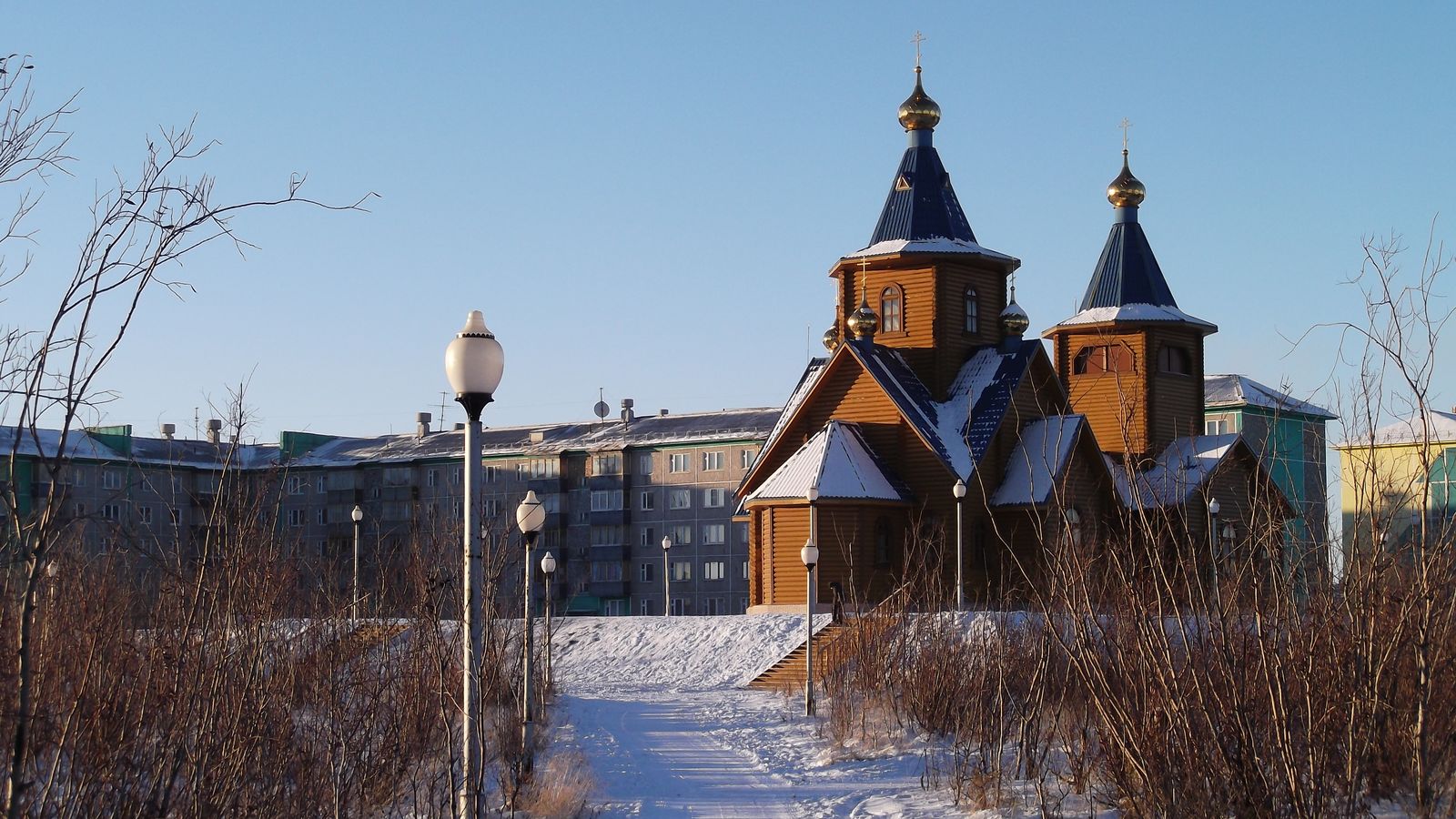
Streetlights glowing over empty avenues in the dead of Arctic night, an automated system still performing its task for pedestrians who will never come. Heating pipes pumping warmth at a cost of seven million dollars annually through apartment buildings with only one inhabitant. In certain neighborhoods, spray-painted messages mark crumbling walls: “people live here”—desperate signals left by residents who have long since fled.
Welcome to Vorkuta, Russia’s largest ghost city.
At its peak in 1989, over 115,000 people called this place home—a city nineteen hundred kilometers from Moscow that sits so far above the Arctic Circle it recorded minus 52 degrees Celsius, among the coldest temperatures in European history. Miners came here chasing wages that made them wealthy by Soviet standards, enduring a place where car engines freeze solid and blizzards can kill you meters from your front door.
Key Takeaways
- Vorkuta, Russia’s largest ghost city, was built on forced labor and mass graves.
- The city’s extreme Arctic conditions make daily life a constant struggle.
- Vorkuta’s population has drastically declined from 115,000 to around 50,000 due to economic and environmental factors.
- The Russian government spends millions annually to maintain heating in empty buildings.
- Residents are trapped by poverty and bureaucratic indifference, with many waiting years to relocate.
Today, the census records around 50,000 residents—though officials quietly suggest the reality is far lower.
What makes Vorkuta different from every other dying city is that it was never supposed to exist—or, not like this anyway. It was a Gulag camp where two million prisoners passed through and 200,000 died—one in ten never leaving alive. They built everything here atop permafrost and mass graves. Then the Soviet Union recruited workers with promises it couldn’t keep, trapping them in the same frozen hell, just without the barbed wire.
Now those promises are dead, and Vorkuta is returning to what it always was: a place that rejects human habitation.
The Frozen Hell
Vorkuta sits so far above the Arctic Circle that it endures extremes even other Arctic settlements find remarkable. This isn’t the picturesque Scandinavian Arctic of fjords and northern lights tourism, it’s the kind of cold that turns exposed skin to frostbite in minutes and creates a landscape where survival becomes a daily struggle for much of the year.
Average mid-winter temperatures hover around minus twenty degrees Celsius, with more than 50 days each year below minus thirty. They have a special kind of blizzard here, called “purgas,” that periodically shut down the city completely in whiteout conditions so severe that residents string rope lines between buildings to avoid becoming lost in the storm. Summers offer some reprieve, but are mild and short, warming only to around 13 degrees on average.
The sun itself becomes something of an unreliable presence here, given how extreme the shift between seasons is due to being so far North. For part of December, the sun never even breaks the horizon, plunging the city into a polar night where the brightest light they experience is an after-sunset dusk. The absence of daylight here tests the human body both mentally and physically, as we have evolved to be exposed to sunlight and largely base our days around being awake when the sun shines and sleeping when it doesn’t.
Then in late May through mid-June, the complete opposite effect kicks in: once again, Vorkuta’s extreme-North location is so far North that the Earth’s tilt means that the sun refuses to set, circling endlessly above the horizon in what’s called the midnight sun. These extremes really do make Vorkuta feel less like a city and more like an experiment in human adaptability pushed to its limits.
Isolation compounds these extremes into something approaching total separation from the external world. No road connects the city to the rest of Russia; the sole year-round connection to the outside world comes via a single rail line built in 1941, which takes more than 40 hours to reach Moscow as it crawls through the Ural Mountains and across the endless northern reaches where human settlements are shockingly few and far between.
Vorkuta does have an airport, which is the much-preferred method of transportation over the nearly two-day train journey, though these flights—which only occur a few times per week—only operate during “good” weather and can be canceled at a moment’s notice due to rapidly-changing weather conditions, an all too common condition when blizzards make even Arctic-hardened pilots refuse to fly.
The cold dictates just about every aspect of daily life that would seem absurd or impossible just about anywhere else. When temperatures drop below negative 30 Celsius, everyday items just stop working the way that they were designed to. This is felt strongest with car batteries, whose chemical reactions slow to a mere crawl that make them essentially useless. Even if you could get the battery jumped, it wouldn’t do you much good anyway—in this climate, the motor oil in the car is so thick that the engine wouldn’t turn over anyway.
Vorkuta’s solution to this involves a complex combination of survival technologies that residents have slowly adapted to over the years. Heated garages are something of a premium in the city, making starting the car a breeze in the mornings compared to the alternative approaches. For those less well off, plug-in engine heaters serve to keep the car warm enough to start in severe frost, which can be seen in winter by the plethora of extension cables running out of buildings. Batteries remain the weakest link, their capacity collapsing in deep cold, which keeps locals busy with jump-starts and replacements throughout the winter months.
Inside the buildings, the cold wages a slower but equally relentless campaign. The doors to apartments routinely freeze shut overnight, making just getting outside a struggle to begin with. Ice in your country builds on the outside of windows? In Russian Vorkuta, it builds up inside them, even with radiators going at full blast around the clock.
The cold’s impact creates one of Vorkuta’s starkest economic paradoxes: above-ground heating pipes snake through the city like exposed arteries, delivering hot water to buildings where only a handful of residents remain—or in many cases, to structures that stand completely empty. The government spends an estimated 570 million rubles annually maintaining heat flow through approximately 15,500 vacant apartments, a seemingly absurd expenditure until you understand the alternative.
If these pipes were allowed to cool and the water inside them to freeze, the expanding ice would rupture the infrastructure entirely, transforming a costly maintenance burden into a catastrophically expensive reconstruction project that would render entire neighborhoods permanently uninhabitable. The system must run not because people need the heat in every building, but because the Arctic itself has taken the city hostage—shut down the flow to save money on empty apartments, and you guarantee the destruction of the network that keeps occupied ones warm, leaving the remaining residents to freeze in buildings that can no longer be heated at any cost.
Daily tasks that you carry out without a second thought become elaborate productions here. Grocery shopping transforms into a race against time as milk and eggs will freeze solid during a walk home if not properly insulated. They literally have to put their eggs in coats. Children growing up here absorb survival knowledge that would sound paranoid anywhere else—never touch metal with bare hands, or your hand will get frozen to it and risk tearing off entire chunks of flesh to break free.
This is what life in Vorkuta actually means: not just enduring cold as an inconvenience, but inhabiting a city that exists in a state of permanent siege, where the environment dictates terms and residents adapt or leave. The cold doesn’t merely make life harder here; it fundamentally redefines what’s possible, turning basic existence into an engineering problem that requires constant vigilance, substantial resources, and a kind of resignation that comes from knowing the battle can never truly be won—only prolonged through another brutal winter, and then another, until the money runs out, the heating fails, or you finally escape.
Built on Bones
By this point you may be asking yourself why on earth anyone would come to this place and decide yes, here is where we need to build not just one city, but a city with over a dozen mini-city satellites surrounding it.
This wasn’t a place that’s been inhabited for hundreds or thousands of years by natives who have grown hardened to the cold—this is a relatively new city, dating back to a single discovery in 1930 that set everything in motion. Georgy Chernov was in the area surveying the desolate tundra along the Vorkuta River for what Stalin’s rapidly-industrializing empire desperately needed: rich coal deposits lying beneath the permafrost in quantities that could fuel factories, steel mills, and the machinery of war.
Within a year, the decision had been made: the coal here was simply too abundant to pass over, and the Union was going to extract it—one way or another, regardless of the human cost. One thing that the Union did have an abundance of at the time was prisoners, who were so numerous that they could be shipped here en masse with little concern for their well being, worked until they were either dead or dying, and then replaced with a fresh wave from Stalin’s purges.
In May of 1931, the first group of roughly forty prisoners, accompanied by geologists and armed guards, trekked north from Ukhta through hundreds of kilometers of trackless wilderness to establish what would become one of the most notorious camps in the Gulag system. They formed the settlement of Rudnik in 1932—many having to sleep in crude huts initially given that the construction of insulated barracks couldn’t keep pace with the flood of new prisoners arriving by train from across the Soviet Union.
This was Vorkutlag, or the Vorkuta Corrective Labor Camp, which would officially operate for the next three decades between 1932 and 1962, and eventually sprawl to encompass no fewer than fifty sub-camps all over the coal-rich region.
During this time, an estimated two million people passed through Vorkutlag’s gates, and approximately 200,000 perished there—roughly one in ten never leaving alive. The journey north itself claimed untold numbers given that Soviet prison transports weren’t exactly first class conditions, and the long ride left many exposed to the unforgiving elements that they were simply unable to withstand.
The composition of Vorkutlag’s population reflected the full spectrum of Stalin’s paranoia: political prisoners branded “enemies of the people,” ethnic minorities swept up in mass deportations, and ordinary citizens arrested for knowing the wrong person. By 1938, the camp held around 15,000 inmates—just a decade later, that number had surged to over 60,000, making it one of the largest Gulag complexes in the entire Soviet system.
The prisoners built everything here. They laid the railroad through the Arctic wilderness that connected the mines to civilization, erected the mine shafts that descended into the permafrost, constructed the processing plants and barracks and guard towers, and hewed millions of tons of coal from underground chambers. These were done in standardized twelve hour shifts in hazardous conditions that all too often became death sentences when methane pockets exploded without warning, inadequate clothing allowed frostbite to set in when temperatures plunged below minus 30, or when food rations calculated to keep prisoners just functional enough to work finally proved insufficient to sustain life.
Yet these workplace deaths—horrific as they were—at least carried the pretense of industrial accident; the camp authorities reserved their most deliberate cruelty for those who broke the rules or attempted escape. Punishments for escape attempts or rule violations were designed to maximize suffering: inmates would be stripped naked and thrown into unheated solitary confinement cells during the polar night, where temperatures inside dropped low enough to cause frostbite within minutes. Most didn’t make it to morning.
This machinery of death reached its full operational capacity during World War II, when Vorkuta’s strategic importance transformed individual tragedy into industrial-scale slaughter. Vorkuta’s coal became crucial to the Soviet war economy during the 1940s. Stalin took a personal interest in the camp as output soared, with annual production doubling between 1942 and 1943 as prisoners were literally worked to death to meet quotas.
The slogan “more coal for the Motherland!” was emblazoned on a building where it can still be seen today, a monument to the thousands who died providing that coal while being told that their suffering served the glory of the Soviet state.
It wasn’t until the tail end of the war, though, that Vorkuta’s true scale really began to take shape. What had started as a remote camp for political prisoners had transformed into a massive industrial operation, one that required more than just untrained forced labor to function at the capacity Stalin’s war economy demanded. To supplement the prison population, Soviet authorities began recruiting engineers, skilled miners, and technical specialists—free workers lured north with promises of salaries significantly above the Soviet average, newly built apartments, and regular vacations to warm Black Sea resorts, all in the name of serving the communist revolution.
Within a few years, tens of thousands of “volunteer”—and we emphasize the uncertainty around just how voluntary these positions truly were—civilians were living in Vorkuta alongside the 60,000 prisoners, creating a surreal society where free families lived in comparative comfort and luxury mere blocks from the camps where their neighbors worked under conditions designed to extract maximum labor before death made replacement necessary.
This uncomfortable arrangement persisted into the 1950s, until Stalin’s death triggered one of the largest uprisings in Gulag history—a strike that lasted weeks and only ended when Soviet troops opened fire, killing no fewer than 53 prisoners whose bodies were buried in unmarked graves now marked by wooden crosses on the tundra. Within a few years, as Khrushchev’s government enacted amnesties and reforms, most political prisoners were released, and the camp began to shrink. By 1962, Vorkutlag was officially closed after three decades of operation.
Watch The Project Briefing
Open Video
Video Briefing
Vorkuta: Hell on Earth
But the Union still needed coal, which remained in abundance here. The Soviet State performed something of a makeover for the city—it had already been recruiting people to come here of their own volition, living alongside the prisoner population. After ‘62, it merely ramped up recruitment with aggressively expanded benefits designed to make people forget what the city was actually like.
During the boom years of the 1960s and 1970s, there were multiple flights to Moscow each day, allowing miners to finish their shifts and spend long weekends in the capital with earnings that made them wealthy by Soviet standards. The city acquired grand Stalinist architecture including the Palace of Culture for Miners completed in 1961, and apartment buildings sprouted across the landscape; by the late 1970s, Vorkuta’s population had swelled above 100,000, with Soviet planners imagining a future where 250,000 people would call this frozen outpost home.
Life Among the Ruins
The city that once symbolized Soviet power to conquer even the Arctic now stands as one of the most extreme examples of urban abandonment on Earth, where the official census claims 56,985 residents remain though local officials quietly admit the real numbers are far lower. The gap represents people who maintain addresses for pension purposes while actually living anywhere else they can manage.
The economics of survival in Vorkuta operate under a system that would be absurd anywhere else on Earth. The cold’s impact creates one of Vorkuta’s starkest economic paradoxes: above-ground heating pipes snake through the city like exposed arteries, delivering hot water to buildings where only a handful of residents remain—or in many cases, to structures that stand completely empty.
The Russian government spends 570 million rubles annually—roughly seven million dollars—to keep heating systems running in roughly one-third of buildings that still contain a few residents, a seemingly absurd expenditure until you understand the alternative. If these pipes were allowed to cool and the water inside them to freeze, the expanding ice would rupture the infrastructure entirely, transforming a costly maintenance burden into a catastrophically expensive reconstruction project that would render entire neighborhoods permanently uninhabitable. The system must run not because people need the heat in every building, but because the Arctic itself has taken the city hostage—shut down the flow to save money on empty apartments, and you guarantee the destruction of the network that keeps occupied ones warm, leaving the remaining residents to freeze in buildings that can no longer be heated at any cost.
For Vladimir Zharuk, who arrived from Ukraine in the 1970s chasing the high miner’s wages that Vorkuta promised, this math has become personal in ways he never imagined when he was younger and the Soviet system, however fragile, seemed eternal. His monthly pension arrives at 25,000 rubles—around $300 and after he pays for winter utilities, there’s barely enough left for food, let alone escape. He applied for the government’s resettlement program over a decade ago—yet despite this, he believes he is somewhere around number 6,000 on the waiting list to relocate out, with around 250 families per year being moved.
At this rate, he jokes, he thinks he’ll get out in just about another 120 years. Here in Vorkuta where 14,000 people are in line to relocate, most will die here waiting for permission to leave at current rates.
Zharuk has become an activist in his retirement, founding a civic group he named “Hostages of the Far North”—a phrase that captures what he and thousands like him have come to understand about their situation. They are prisoners of an economic trap, held hostage by poverty and a non-functioning housing market.
The deal was explicit when Zharuk arrived: endure the brutal conditions, accept the isolation and danger, but in return receive cheap housing and wages far higher than he could have hoped for elsewhere that could support a family, frequent vacations, and a trip out. Yet that social contract has been systematically broken, first during the collapse of the Soviet Union, then by decades of complete indifference from the Russian government.
Beyond economics, daily life in Vorkuta has become something of a study in managed decline. The city that once boasted over thirty medical facilities now maintains just one main hospital, and when someone suffers a serious illness or injury requiring specialized care, they have to be medivacked either by train or plane to Syktyvkar, 900 kilometers away through wilderness and cold—a trip that becomes impossible during the worst winter storms when medical evacuation means waiting for weather to clear. It sometimes comes down to just hoping the patient survives long enough for a window to open.
The human cost here manifests in statistics that elsewhere would be shocking but have been normalized in Vorkuta. Depression permeates the city, with suicide attempts spiking during the polar night when the sun refuses to rise for days on end. More common are the less obvious forms: losing someone to either alcohol abuse or drugs has become grimly routine. One older resident shared that he lost his son to alcohol and his granddaughter to a drug overdose, tragedies he directly links to the lack of hope and purpose for young people here.
Against this darkness, there actually are some encouraging attempts to make the best of the situation. Russia is infamous for its vast expanses of dreary, grey, brutalist buildings throughout much of the country—but this is actually not the case in much of Vorkuta and its satellites, where many are painted in almost aggressive shades of blue and yellow that serve both as navigation during blizzards while doubling as psychological warfare against despair in the never-ending cold. Support groups meet in Orthodox churches, soup kitchens operate for struggling families, and residents cling to small moments of normalcy wherever they can find them.
The Palace of Culture stands as perhaps the most striking symbol of this defiance—an elaborate building constructed in 1961 when the city was thriving that still hosts events ranging from ballet to concerts. Inside this grand theater with its ornate stage and rows of velvet seats, you can still find children attending ballet classes beneath Soviet mosaics, a surreal image of grace and ambition persisting while the population outside dwindles year by year.
This is what remains of Soviet ambition in the Arctic: a city kept barely alive by government subsidies that heat empty buildings, populated by people too poor to leave and too stubborn to give up entirely, where every winter becomes a test of whether the will to survive can outlast the mathematics of abandonment. Yet if you think life in Vorkuta proper is grim, you haven’t seen the settlements that ring it—the ghost towns where abandonment has already won.
The Ring of Death
At Vorkuta’s height, there were no fewer than thirteen mining settlements that radiated outward from the main city like hours on a clock face, each one built around its own coal mine, complete with schools, clinics, cultural centers, and the full apparatus of Soviet urban planning. They were complete communities where thousands of families built lives, raised children, and believed that they were participating in building something permanent, something lasting. When the coal flowed and Moscow’s subsidies arrived on schedule, these settlements thrived with the kind of rough prosperity that frontier communities often achieve—higher than average wages and tight-knit communities, in spite of the enormously hostile environment around them.
Cracks were forming as the Union began to decline in the ’80s, though. By 1989, Vorkuta’s miners were striking for better pay and conditions as the system was faltering around them, and the population that had peaked that year at 115,646 began to decline—never to reverse course again.
These Arctic mines had never been economically self-sufficient. They existed out of economic necessity during the heyday of coal-fueled power along with—especially in its earlier days—a place to put people where they wouldn’t be seen or heard from again. The government had to pour enormous subsidies into keeping the city operational.
When the Union finally collapsed in ‘91, it took those subsidies along with it. The transition, called “shock therapy,” was catastrophic across Russia—hyperinflation wiped out savings overnight and state services collapsed. But for Vorkuta, the crisis simply revealed what had always been true: these mines had never made economic sense. They existed not to fulfill some dire economic need in Russia’s economy, but because the Soviet state originally needed somewhere to put its ideological prisoners where they could be at least somewhat useful.
As the 1990s progressed, the newly privatized mining companies looked at the actual cost of extraction versus the value of the coal and increasingly reached the conclusion that they should be closed. Many were shuttered by the early 2000s, a trend that has continued through to this day—each closure stripping away another settlement’s reason for existence.
The death of Vorkuta’s satellite towns came swiftly and without mercy. Mines closed one after another throughout the decade as the enormously bloated state-owned companies crumbled without the Soviet state propping them up. Their abysmal safety record wasn’t exactly helping the cause, either—frequent injuries combined with occasional explosions, like the one at Severnaya mine in February 2016 that killed thirty-six miners and rescuers when methane gas ignited deep underground, forcing the permanent closure of what had been one of the last major operations. When your workers are dying in explosions just to extract coal that costs more to mine than it’s worth, the conclusion becomes obvious.
Each mine closure meant something far more devastating than lost jobs: it meant the end of entire communities. These satellite settlements—places like Komsomolsky, Severny, and Vorgashor—existed for one reason only: to house the miners and their families near the pit heads. When the mines shut down, there was no alternative employment, no economic reason for anyone to stay, and critically, no justification for the government to continue maintaining the infrastructure that kept these Arctic outposts habitable. The exodus that followed wasn’t a matter of choice but of survival.
The departures were chaotic and traumatic, with some families escaping more easily than others. The government does offer a resettlement program for those who want to leave, but it’s sluggish at best—many wait years for approval while trapped in dying towns. Those who couldn’t wait—or couldn’t get approval from the state to relocate at all—simply packed what they could carry and headed south, leaving behind everything else. Families abandoned apartments with furniture, clothes, even family photos still inside—as if they intended to return but never did.
What remains in these apartments shows what happens when Arctic cold invades habitable environments: burst pipes have flooded entire floors that froze into solid sheets of ice, moisture has penetrated walls and frozen, expanding until plaster cracks and concrete crumbles, frost coats every surface in thick layers. Unlike the outdoors, where cold can preserve things, the invasion of frigid temperatures into these buildings accelerates their destruction, making them completely uninhabitable for future occupants.
Officially, three-room flats in settlements like Komsomolsky are listed for around 100,000 rubles—roughly $1,300 dollars—representing the absolute bottom of Russia’s housing market, though even these rock-bottom prices reflect only the most desperate sales in buildings with failing utilities or mounting arrears. Yet even at these absurdly low prices, there are no buyers for apartments in the truly dying settlements; some desperate owners have tried giving apartments away for a single ruble, yet even these bargain sellers struggle to find takers. There simply isn’t a market for people looking to live in crumbling, frozen ghost towns where entire communities have already fled and basic services are being systematically shut down.
Outside the five-story housing blocks that lie in ruins, you’ll occasionally see chalk or spray-painted messages declaring “people live here” or “section inhabited” scrawled on walls by the last residents—desperate signals to utility workers not to shut off heat or electricity to sections they assume are empty, and warnings to looters who strip copper wiring and pipes from abandoned apartments.
Most of these messages now mark entrances to buildings that are completely empty, the authors of the graffiti long since departed, their warnings preserved in fading paint as epitaphs for communities that no longer exist.
Locals grimly refer to this constellation of settlements as the “Ring of Death,” and walking through them reveals why the nickname fits. The approach by train from the south captures the full scope of the devastation—as you crawl through forty hours of journey from Moscow, the last stations before Vorkuta show you’re leaving civilization behind; then ghost towns begin appearing through the window, one after another, hulks of abandoned guard towers from the Gulag era still standing sentinel over settlements that no longer exist. The silence is what hits you first—an absence of sound so complete that your own footsteps on frozen pavement feel like a violation. Then come the details that make the abandonment real.
Take Komsomolsky, which once housed twenty thousand people. When journalists from Radio Free Europe visited in 2021, they found a settlement that had shrunk to around 200 residents. The streets are illuminated by functioning streetlights that glow over empty avenues each night—an automated system still performing its duties for pedestrians who will never come. The buildings themselves tell the story of rapid abandonment: windows broken out from vandals or the freeze-thaw cycle, doors hanging at odd angles, snow drifting into lobbies where mailboxes still bear the names of families who left a decade ago.
The mine in this settlement still operates, and is the deepest in all of Russia at over 1,100 meters. But the workers don’t live here anymore—they’re bussed in daily from Vorkuta city proper, rather than living in the ghost town above. They descend into the earth each shift, extract coal from chambers deep below the permafrost, then return to the surface and board buses that carry them back to the marginally more inhabited main city—a daily reminder that the town above the mine has outlived its purpose.
Severny tells a similar story but with its own particular tragedy. Twenty thousand people once called this settlement home, until that February 2016 methane explosion killed 36 and forced the mine’s closure. The population has since dwindled to around 3,600, mostly pensioners too poor to relocate and workers in related industries still clinging to what little work remains. Walk through apartment blocks and you’ll find the jarring contrast that makes up Vorkuta and its surroundings: entire buildings that on first appearance look to be abandoned, with frost biting deep into the exposed units—until upon closer examination, you’ll find one unit with a light still on, the only sign of life in eyesight.
Life in Vorkuta proper may not be a cakewalk, but it is far easier than out here. As the city has slowly been abandoned, the remaining residents have pulled together to be closer—some of the city is entirely abandoned, while certain sections look at least half inhabited. But here, you’re really on your own. Like, only inhabited unit of your building alone.
Other settlements in the ring have crossed the threshold into complete abandonment. In some, you can still find artifacts of the lives lived there: children’s toys, family photos inside the abandoned units. That is, if you can even get there—the fully abandoned satellites no longer have their road to Vorkuta maintained, so most of the year, the only way in or out is by snowmobile.
When summer arrives and the snow melts, these settlements reveal what winter hides: cracked asphalt emerging from beneath the ice, rusted playground equipment with swings buried in stagnant puddles, weeds pushing through pavement, graffiti on crumbling walls. The tundra around them blooms briefly with tiny wildflowers in July—a burst of life that makes the human ruins seem even more desolate by contrast.
On clear winter nights, the Northern Lights dance above these skeletal high-rises at minus forty degrees, green and purple auroras swirling above empty windows in a display of natural beauty utterly indifferent to human struggles below.
Conclusion
In Vorkuta today, you will still see proclamations of “more coal for the Motherland!” emblazoned on buildings, visible to anyone who passes by. It stands as a monument to the 200,000 prisoners who died being told their suffering served some greater purpose, that their sacrifices mattered. The slogan remains because no one has bothered to remove it, which seems fitting: Vorkuta has always been a place where the living coexisted with the dead, building their lives atop mass graves and pretending the foundations aren’t made of corpses.
This, ultimately, is the heart of what Vorkuta represents: the Soviet willingness to sacrifice human lives. The calculation was simple—coal deposits justified the cost, and human life was the one resource that the Union possessed in excess.
Now, though, the same process of bringing people here against their will is being played out in reverse. The 50,000 or so people who remain aren’t staying because they believe in the city or think it has a future, they’re staying because poverty and bureaucratic indifference have trapped them here. Some paint their buildings bright colors and try to pass time in the Palace of Culture—small acts of defiance that feel almost revolutionary in their efforts to pretend that normalcy is possible here. But these gestures can’t change the fundamental maths: every year the population shrinks and every winter more pensioners die waiting for resettlement.
What obligation does a state have to citizens it deliberately settled in impossible places—whether by force, or by false promises? The Soviet Union built Vorkuta with prisoner labor, then recruited free workers with explicit guarantees of a better quality of living. Both forms have been completely abandoned, leaving behind thousands who discovered too late that whether you arrive in chains or chasing promises, Vorkuta doesn’t let you go.
In the end, Vorkuta reveals what happens when a state treats geography as an enemy to be conquered through willpower and expendable lives. Stalin’s coal quotas were met, the machinery of war was fueled, but that purpose was always temporary, always built on the delusion that brutality could create something permanent in a place that fundamentally rejects human habitations.
Tonight, the streetlights of Vorkuta glow over empty streets, an automated system performing its duties for a population that largely no longer exists. They’ll keep burning until the bulbs finally die or the grid completely collapses—whichever comes first. Until then, the city endures—not as a symbol of anything except the simple truth that some battles against nature cannot be won, and that those who died fighting them deserved better than to be forgotten in the permafrost of a city that, realistically, never should have been built.

Simon Whistler
Simon Whistler is one of YouTube's most prolific educational creators, with tens of millions of subscribers across his channels. Places is his expedition into the world's most remarkable locations — from cities carved from salt to islands nobody dares inhabit. He brings a researcher's rigour and a traveller's awe to every field note.
Frequently Asked Questions
What is the current population of Vorkuta?
The census records around 50,000 residents, though officials suggest the reality is far lower.
What was the peak population of Vorkuta?
At its peak in 1989, over 115,000 people called Vorkuta home.
What are the extreme weather conditions in Vorkuta?
Vorkuta endures average mid-winter temperatures around minus twenty degrees Celsius, with more than 50 days each year below minus thirty. The city experiences polar night in December and midnight sun from late May through mid-June.
What is the significance of the heating pipes in Vorkuta?
The government spends approximately 570 million rubles annually to maintain heat flow through vacant apartments to prevent the infrastructure from being destroyed by freezing water.
What was the original purpose of Vorkuta?
Vorkuta was originally a Gulag camp where two million prisoners passed through and 200,000 died. It was built on permafrost and mass graves.
How did the Soviet Union recruit workers to Vorkuta?
The Soviet Union recruited workers with promises of high wages, newly built apartments, and regular vacations to warm Black Sea resorts.
What is the ‘Ring of Death’ in Vorkuta?
The ‘Ring of Death’ refers to the thirteen mining settlements that radiated outward from the main city, which have largely been abandoned as the mines closed.
What is the current state of the satellite towns around Vorkuta?
Many of the satellite towns are now ghost towns, with some having only a few hundred residents left. The mines that supported these towns have closed, leading to mass exodus.
What is the resettlement program for Vorkuta residents?
The resettlement program is sluggish, with many waiting years for approval. Only around 250 families per year are moved, leaving thousands on waiting lists.
What is the economic paradox of heating in Vorkuta?
The government spends millions to keep heating systems running in empty buildings to prevent the infrastructure from being destroyed by freezing water, which would make the remaining occupied buildings uninhabitable.
Sources
- Original Places video: Vorkuta: Hell on Earth
- https://citypopulation.de/en/russia/komi/_/87710000001__vorkuta/https://www.rferl.org/a/russia-vorkuta-soviet-mining-abandoned-gulag-arctic-exodus/31196830.html
- https://en.wikipedia.org/wiki/Vorkuta_uprising
- https://newlinesmag.com/reportage/where-the-russian-gulag-once-thrived-life-remains-isolated/
- https://www.rferl.org/a/stalin-gulag-vorkuta/24918538.html
- https://www.youtube.com/watch?v=-cRUuYrRbC8
- https://www.youtube.com/watch?v=Ci5Ay3BxSWo
- https://www.citypopulation.de/en/russia/places/komi/vorkuta/87710000091__severnyj/
- https://www.gw2ru.com/travel/1490-vorkuta-ring-abandoned-settlements
- https://regnum.ru/article/2787574
- https://www.youtube.com/watch?v=PXpJs-myJIQ
- https://www.youtube.com/watch?v=Z64WAnjh6ZQ
- Hero image source by f-Lars / openverse, by.